Since the late 1990s, when the internet moved from government laboratories into homes and offices around the world, people began to believe that algorithms are all-powerful, the source of intelligence. After all, algorithms made billions of dollars for companies and helped create entire new industries. That idea is even more prevalent today with artificial intelligent algorithms powering devices that we can talk to, like Siri and Alexa, and even drive cars, like Tesla. There are those who suggest that you and I are nothing more than a lump of algorithm-driven meat. But, not so fast. In More Than An Algorithm, Antonin Tuynman takes the reader on a mind-spinning, often contrarian trip into the heart of the argument that algorithms are the sole — or soul — source of intelligence. Tuynman is unafraid of taking on the heavyweights of science — like quantum physicist David Deutsch — to put forth his own ontology that mixes modern technology with ancient spiritual wisdom. This is a must-read, must-ponder books as our society finds itself making a monumental shift into the future that even the most fertile imaginations will struggle to comprehend. Tuynman makes a worthy guide for this trip into the future.” -Matt Swayne, Science Writer
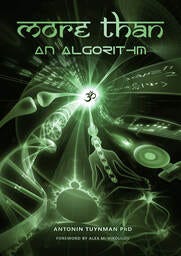
Recently my book “More than An Algorithm” was published by Ecstadelic Media. This book is the sequel to my previous book “Is Intelligence an Algorithm?”
In this article I will share with you my blurb and the foreword written by Alex M. Vikoulov, author of “The Syntellect Hypothesis”.
Blurb
Do we have a free will or do all our actions routinely unwind as a chemical watch? Are we merely fooled by the jester of our consciousness to believe that we are in charge? How do we reschedule and repurpose when Fortuna’s unforeseen circumstances present themselves? Is everything mere computation or do even computers fail to compute? If you wish to dive deeper into these questions left open by my previous volume “Is Intelligence an Algorithm?”, then this is the book for you.
Let me invite you to the musings of master algorithms, brain fractals and Chinese rooms. Allow me to make you question the validity of the multiple worlds interpretation, allow me to seduce you with Eris’ apple of the paradoxical idealistic panpsychism and allow me to show you the parallels between the codes of evolution and the routines of the human mind. Let’s dive in the intuitive dimensions of Archimedes’ Eureka! Let’s descend into the rigid mechanics of the mental Tartaros, calcinate our prejudices and rise from the ashes of our Chrysopoeia as a Phoenix enlightened with the knowledge that we can be more than an Algorithm.
Foreword by A.M.Vikoulov
As a little kid I remember hearing from my father all kinds of stories sort of like this one: A father wanted to test the intelligence of his two sons. He assigned to each of them the task of looking after a cherry tree, and promised to reward the boy whose tree would yield the best berry when harvested.
One of the boys saw that the leaves were withering off and flowers were coming out at the end of the branches. So, he decided to carefully water every leaf and every flower. The tree withered still more and eventually died.
The smarter boy, on the other hand, went on watering the root; the tree stayed green and healthy and yielded an abundant harvest of delicious cherries.
My father who was very good at teaching (no wonder, he was an instructor at a technology college early in his career) taught me to always look beyond the apparent, to always try to start with the bigger picture and work out the details as you go along, locate the source or reason of any challenging situation or find some other invisible root cause in order to better comprehend a task at hand. “We learn throughout our lives, son,” my dad used to say, “the faster you learn, the better.”
The smarter boy, on the other hand, went on watering the root; the tree stayed green and healthy and yielded an abundant harvest of delicious cherries.
My father who was very good at teaching (no wonder, he was an instructor at a technology college early in his career) taught me to always look beyond the apparent, to always try to start with the bigger picture and work out the details as you go along, locate the source or reason of any challenging situation or find some other invisible root cause in order to better comprehend a task at hand. “We learn throughout our lives, son,” my dad used to say, “the faster you learn, the better.”
The essence of intelligence is learning and applying the acquired knowledge to achieve complex goals. The age of intelligence augmentation is upon us, which makes the present book even more compelling to obtain and study, especially for experts working in the field of cognitive science, neuroengineering, and artificial intelligence.
This short book can be read not only as a supplement to the previously published volume “Is Intelligence an Algorithm?”, but also as an academic treatise or a long essay in its own right perhaps with an alternative title: Is Intelligence More Than An Algorithm?: An Interdisciplinary Approach to Tackle The Paradoxes of Learning and Intelligence.
Throughout human history we’ve seen a gradual appreciation of the premium for intelligence up to a point sometime perhaps in our own future where most, if not all, physical attributes might simply fade away in comparison.
One of the earliest furors on the premium for intelligence well may be an ancient Indian chess folk tale. The tradition of serving Paal Paysam made of rice to visiting pilgrims started after one legendary game of chess. The story goes somewhat like this: The local king was a well-known chess enthusiast, and welcomed anyone who could be a worthy opponent. So, one day a travelling sage appeared on the doorsteps of his palace and challenged him to play the game of chess.
The king offered any reward that the sage could name. Humbly, the sage asked for a single grain of rice to put on the first chess square and double it on every consequent one, if he wins. King agreed to this and the game began. Having lost the game and being a man of his word the king ordered a bag of rice to be brought to the chess board.
The king started placing the grains according the reward arrangement quickly realizing that he would be unable to fulfill his promise because on the nineteenth square he would have had to come up with 1,000,000 grains of rice. And, finally on the sixty fourth square the king would have had to put more than 18x10¹⁶ grains of rice which equates to untold trillions of tons of rice!
It was at that point that the sage revealed himself as Krishna and told him that he doesn’t have to pay the debt right away but can do that over time. That is why to this day visiting pilgrims are still feasting on Paal Paysam and the king’s debt to Krishna is still being repaid.
This parable demonstrates an immense power of exponential growth present in our today’s information technologies but as intended here — the premium for intelligence — it seems that the King of Ambalapuzzha will never be able to pay off his debt in full to Krishna.
So, how can we define intelligence? And why is it more than an algorithm? I don’t mean to oversimplify what Dr. Tuynman has to say in the present book and I can’t agree with him more — intelligence is more than an algorithm — it is a meta-algorithm, more specifically meta-algorithmic information processing with certain emergent properties like network effects and conscious awareness in us human beings.
When we think of algorithms, step-by-step information processing, we think of machines and mechanisms. When we think of meta-algorithms, layered feedback-driven complexity and metabolic activity, we think of organisms. In this treatise, Dr. Tuynman seems to counter the Computational Hypothesis (at least the most straightforward version of it) according to which organic algorithms are our neural codes, i.e. “software of the mind.” But what if we can expand the Computational Hypothesis in order to reverse engineer our human intelligence and self-awareness?
In this sense, a claim that I submit to you in my recent book The Syntellect Hypothesis, organismic intelligence, this meta-algorithmic information processing, is what can be rightly viewed as consciousness, i.e. our conscious awareness. Viewed in this way, consciousness turns out what information processing feels like to a conscious “computing” mind.
Dr. Tuynman in “More than an Algorithm” puts it slightly in different words but essentially he means the same: Finding the right algorithms and subroutines to follow, applying optimization, performing analysis, executing [careful] pruning, and finally synthesis constitutes a holistic, streamlined process to us as intelligent agents. But the devil is in the details, they say, so I can attest to you that you’ll find plenty of insights and surprises as you read along this extraordinary volume.
Dedicating an entire chapter to it, Dr. Tuynman seems to be enamored with Tsang’s “The Fractal Brain Theory”(and so am I) which posits, as its name implies, that the brain has a fractal structure on many genetic and abstract cognitive levels. It employs a combination of forward chaining and backward chaining, just like certain types of heuristics in artificial intelligence. The author makes a special emphasis on mapping as the unifying process underlying all natural processes and recursive self-modification.
Dr. Tuynman warns us that human intelligence cannot be simply reduced to underlying algorithms since consciousness itself is what should be considered a truly “ontological primitive” with qubits/bits of information as reality’s building blocks. Attributes of intelligence of a human species should include but be not limited to: higher-order abstract thinking, intuition, imagination, creativity, and finally wisdom, even though they haven’t been formally recognized as types of intelligence. Intuition may be one of the highest forms of intelligence, according to some psychologists. To others, imagination.
Tuynman shows to us that Nature’s fluidity of intelligence is due to its syntactical underpinnings: Nature is neither fully deterministic nor fully random. Rather, Nature uses her own language based on various codes from clearly defined genetic codes to immaterial neural codes to less obvious societal ones. Intelligence evolves and its evolution appears to be linguistic, or a code-theoretic teleological process. The philosopher gives us his definition of this Telos (in Greek, “purpose”): Nature purposefully organizes itself, so clearly it is not random.
Demystifying a curious and ever-present phenomenon of emergence to the best of our current understanding, Dr. Tuynman shows that both Nature and Mind interact as many experiencers to become one again, at a higher meta-system level. Or, as I put it, alternating from pluralities to singularities, and from singularities back to pluralities, creative singular consciousness expressing itself throughout the [virtual] multiverse.
God becomes intelligible through this Nature’s phenomenon of emergence: Universal consciousness is said to emerge somewhere ahead of us in space-time, however, IT transcends our conventional dimensionality and is already here within each of us. This also implies that all information is integrated at one level; all our individuated experiences are simultaneously observed from a higher level and integrated in a single experiential self — the Overmind — there’s really One Mind, the one we all share, a philosophical worldview known as ‘Idealism’.
Is reality entirely mechanistical, as proponents of determinism would claim? Or, is it teleological? Just by looking at accelerating complexification of the Universe of which we are an integral part, we can conclude that we are not subjected to a random walk of evolution, nor are we subjected to a deterministic script of Nature, the truth lies somewhere in between — we are part of teleological evolution.
In the book you’ll encounter some hefty dose of healthy criticism of quantum computing pioneer David Deutsch’s ideas on quantum determinism stemming from Many-Worlds Interpretation. And I wholeheartedly support that criticism.
In the chapter on free will, we get to discuss free will against the backdrop of quantum mechanical principles which I found especially fascinating. Tuynman shows that our Universe transcends the dichotomy of determinism vs. non-determinism and that it actually allows both at the same time and even allows one to cause the other and vice versa. By the way, speaking of algorithms, meta-algorithms and free will, I refer to our sense of agency, i.e. free will, as “Quantum algorithm of consciousness” in my own work.
In this sense, a claim that I submit to you in my recent book The Syntellect Hypothesis, organismic intelligence, this meta-algorithmic information processing, is what can be rightly viewed as consciousness, i.e. our conscious awareness. Viewed in this way, consciousness turns out what information processing feels like to a conscious “computing” mind.
Dr. Tuynman in “More than an Algorithm” puts it slightly in different words but essentially he means the same: Finding the right algorithms and subroutines to follow, applying optimization, performing analysis, executing [careful] pruning, and finally synthesis constitutes a holistic, streamlined process to us as intelligent agents. But the devil is in the details, they say, so I can attest to you that you’ll find plenty of insights and surprises as you read along this extraordinary volume.
Dedicating an entire chapter to it, Dr. Tuynman seems to be enamored with Tsang’s “The Fractal Brain Theory”(and so am I) which posits, as its name implies, that the brain has a fractal structure on many genetic and abstract cognitive levels. It employs a combination of forward chaining and backward chaining, just like certain types of heuristics in artificial intelligence. The author makes a special emphasis on mapping as the unifying process underlying all natural processes and recursive self-modification.
Dr. Tuynman warns us that human intelligence cannot be simply reduced to underlying algorithms since consciousness itself is what should be considered a truly “ontological primitive” with qubits/bits of information as reality’s building blocks. Attributes of intelligence of a human species should include but be not limited to: higher-order abstract thinking, intuition, imagination, creativity, and finally wisdom, even though they haven’t been formally recognized as types of intelligence. Intuition may be one of the highest forms of intelligence, according to some psychologists. To others, imagination.
Tuynman shows to us that Nature’s fluidity of intelligence is due to its syntactical underpinnings: Nature is neither fully deterministic nor fully random. Rather, Nature uses her own language based on various codes from clearly defined genetic codes to immaterial neural codes to less obvious societal ones. Intelligence evolves and its evolution appears to be linguistic, or a code-theoretic teleological process. The philosopher gives us his definition of this Telos (in Greek, “purpose”): Nature purposefully organizes itself, so clearly it is not random.
Demystifying a curious and ever-present phenomenon of emergence to the best of our current understanding, Dr. Tuynman shows that both Nature and Mind interact as many experiencers to become one again, at a higher meta-system level. Or, as I put it, alternating from pluralities to singularities, and from singularities back to pluralities, creative singular consciousness expressing itself throughout the [virtual] multiverse.
God becomes intelligible through this Nature’s phenomenon of emergence: Universal consciousness is said to emerge somewhere ahead of us in space-time, however, IT transcends our conventional dimensionality and is already here within each of us. This also implies that all information is integrated at one level; all our individuated experiences are simultaneously observed from a higher level and integrated in a single experiential self — the Overmind — there’s really One Mind, the one we all share, a philosophical worldview known as ‘Idealism’.
Is reality entirely mechanistical, as proponents of determinism would claim? Or, is it teleological? Just by looking at accelerating complexification of the Universe of which we are an integral part, we can conclude that we are not subjected to a random walk of evolution, nor are we subjected to a deterministic script of Nature, the truth lies somewhere in between — we are part of teleological evolution.
In the book you’ll encounter some hefty dose of healthy criticism of quantum computing pioneer David Deutsch’s ideas on quantum determinism stemming from Many-Worlds Interpretation. And I wholeheartedly support that criticism.
In the chapter on free will, we get to discuss free will against the backdrop of quantum mechanical principles which I found especially fascinating. Tuynman shows that our Universe transcends the dichotomy of determinism vs. non-determinism and that it actually allows both at the same time and even allows one to cause the other and vice versa. By the way, speaking of algorithms, meta-algorithms and free will, I refer to our sense of agency, i.e. free will, as “Quantum algorithm of consciousness” in my own work.
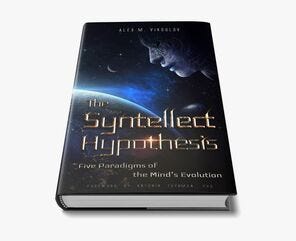
In line with Antonin Tuynman’s prognostications, my above-mentioned book, The Syntellect Hypothesis: Five Paradigms of the Mind’s Evolution, where the word ‘Intelligence’ was mentioned 229 times, and where I introduce the term ‘Intelligence Supernova’, also emphasizes that one of the most probable directions to develop AI and finally reach human-level AGI in the near future, would not be accomplished through commonly used today Deep Learning alone. But rather, in the coming years we could see not only the combination of bottom-up, top-down and interlinking (cybernetic) approaches to Machine Learning but we could witness more emphasis on ‘Evolutionary Computing’, known today as ‘Reinforcement Learning’ — we will need to teach self-aware AI to think for themselves in novel situations — the way our children learn the ropes of general intelligence.
In the 1980s, computer scientist Hans Moravec laid out the most challenging part of creating AGI — what has now been dubbed The Moravec Paradox — and explained why it’s just what we should expect from machines that are immune to the pressures of natural selection. “Encoded in the large, highly evolved sensory and motor portions of the human brain is a billion years of experience about the nature of the world and how to survive in it,” he wrote in his 1988 book “Mind Children.” “The deliberate process we call reasoning is, I believe, the thinnest veneer of human thought, effective only because it is supported by this much older and much more powerful, though usually unconscious, sensorimotor knowledge.” As a rule, what’s easy for humans is extremely difficult for Artificial Intelligence, and vice versa, what’s supposed to be easy for AI is an impossible task for humans.
From the evolutionary standpoint, carbon-based intelligence represents enabling factors for silicon-based intelligence to come to existence. If Nature could find its way to engender intelligence and self-reflective consciousness in humans, sooner or later, we’ll be able to replicate cognitive functionality and self-awareness in our “Mind Children,” in our machine counterparts.
Sometimes we’re leery to what we call metaphysics but every human being, be it a scientist, an entrepreneur, or a doctor, is by definition a “metaphysician.” We start with a set of assumptions and then we try to work out our hypotheses. Even our Nobel-winning models are only provisional at best and are to be replaced by newer more sophisticated models with the next paradigmatic shift.
The Universe is not what textbook physics tells us. The Big Bang theory, for example, drawing a lot of criticism as of late, uses a starting assumption of the “Universe from nothing,” (a ‘quantum fluctuation’ in a scientific jargon), or the initial Cosmological Singularity. But aside from this highly improbable happenstance, we can just as well operate from a different set of assumptions and place the initial Cosmological Singularity at the Omega Point — the transcendental attractor, or the omniversal holographic projector of all possible timelines.
In his book, Dr. Tuynman makes his case for Digital Akasha, a sort of Prima Materia, or the primordial conscious energy, and shares his views on the famed Simulation Hypothesis, the hard problem of consciousness, as well as the hermeneutic approach as a possible avenue towards AGI.
Do I agree with everything Dr. Tuynman writes in his book? Not necessarily. But most of our views as digital philosophers are incredibly in sync and our minds are now [quantum-]entangled going forward. We keep on surprising each other on a regular basis, bouncing ideas from one another and fostering our collaboration which should result in more co-authored publications (you might savor our stylistic differences present in this book as well). Along with other like-minded intellectuals, it’s a powerful ecology of minds. Reading Antonin’s works sometimes makes me think that I’m reading my own thoughts including some conflicting ones, as each of us has from time to time.
In the 1980s, computer scientist Hans Moravec laid out the most challenging part of creating AGI — what has now been dubbed The Moravec Paradox — and explained why it’s just what we should expect from machines that are immune to the pressures of natural selection. “Encoded in the large, highly evolved sensory and motor portions of the human brain is a billion years of experience about the nature of the world and how to survive in it,” he wrote in his 1988 book “Mind Children.” “The deliberate process we call reasoning is, I believe, the thinnest veneer of human thought, effective only because it is supported by this much older and much more powerful, though usually unconscious, sensorimotor knowledge.” As a rule, what’s easy for humans is extremely difficult for Artificial Intelligence, and vice versa, what’s supposed to be easy for AI is an impossible task for humans.
From the evolutionary standpoint, carbon-based intelligence represents enabling factors for silicon-based intelligence to come to existence. If Nature could find its way to engender intelligence and self-reflective consciousness in humans, sooner or later, we’ll be able to replicate cognitive functionality and self-awareness in our “Mind Children,” in our machine counterparts.
Sometimes we’re leery to what we call metaphysics but every human being, be it a scientist, an entrepreneur, or a doctor, is by definition a “metaphysician.” We start with a set of assumptions and then we try to work out our hypotheses. Even our Nobel-winning models are only provisional at best and are to be replaced by newer more sophisticated models with the next paradigmatic shift.
The Universe is not what textbook physics tells us. The Big Bang theory, for example, drawing a lot of criticism as of late, uses a starting assumption of the “Universe from nothing,” (a ‘quantum fluctuation’ in a scientific jargon), or the initial Cosmological Singularity. But aside from this highly improbable happenstance, we can just as well operate from a different set of assumptions and place the initial Cosmological Singularity at the Omega Point — the transcendental attractor, or the omniversal holographic projector of all possible timelines.
In his book, Dr. Tuynman makes his case for Digital Akasha, a sort of Prima Materia, or the primordial conscious energy, and shares his views on the famed Simulation Hypothesis, the hard problem of consciousness, as well as the hermeneutic approach as a possible avenue towards AGI.
Do I agree with everything Dr. Tuynman writes in his book? Not necessarily. But most of our views as digital philosophers are incredibly in sync and our minds are now [quantum-]entangled going forward. We keep on surprising each other on a regular basis, bouncing ideas from one another and fostering our collaboration which should result in more co-authored publications (you might savor our stylistic differences present in this book as well). Along with other like-minded intellectuals, it’s a powerful ecology of minds. Reading Antonin’s works sometimes makes me think that I’m reading my own thoughts including some conflicting ones, as each of us has from time to time.
-Alex Vikoulov
Alex Vikoulov is a futurist, digital philosopher, neo-transcendentalist, transhumanist singularitarian, evolutionary extrapolist, cosmist, independent scholar, founder of Ecstadelic Media Group, painter, media artist, essayist, co-author of “Is Reality a Simulation?” (2018), author of “The Syntellect Hypothesis: Five Paradigms of the Mind’s Evolution,” “The Origins of Us: Evolutionary Emergence and The Omega Point Cosmology,” “The Physics of Time: D-Theory of Time & Temporal Mechanics” (2019). Lives in Burlingame, California (San Francisco Bay Area).
About The Author of “More Than An Algorithm”
Antonin Tuynman studied Chemistry at the University of Amsterdam, achieving both an MSc and a PhD, and worked as a postdoc researcher at the “Université René Descartes Paris V” in Paris.
Since 2000, Tuynman has worked as a patent examiner at the European Patent Office (EPO) in the fields of clinical diagnostics, computational chemistry and biomaterials. He has vast experience in meditation and yoga, and a strong interest in Hinduism and Buddhism. He also has strong affinity for futurism and the Singularity theory of Kurzweil.
In his books, Tuynman proposes Artificial Intelligence concepts which may lead to the emergence of internet as a quasiconscious entity using stratifications from Vedic scriptures.
Since 2000, Tuynman has worked as a patent examiner at the European Patent Office (EPO) in the fields of clinical diagnostics, computational chemistry and biomaterials. He has vast experience in meditation and yoga, and a strong interest in Hinduism and Buddhism. He also has strong affinity for futurism and the Singularity theory of Kurzweil.
In his books, Tuynman proposes Artificial Intelligence concepts which may lead to the emergence of internet as a quasiconscious entity using stratifications from Vedic scriptures.
