Showing posts with label Steven Kaufman. Show all posts

Monday, 19 March 2018

Reality, the Mystical Self-Referential Descent into Imagination


In his article "The Self-Referential Aspect of Consciousness" Cosmin Visan [1] explains in great detail how Self-Reference (SR) brings Consciousness into existence. He also describes how consciousness is structured on a hierarchy of phenomenological levels as manifestations of self-reference, which he names Self, Vividness, Diversity, Memory and Time. However, he describes a remaining problem as regards how self-reference picks up essences, give us exactly the qualia domains we have and not others.
Although I will certainly not claim to have solved this problem I would like to take you on a mystical journey into additional possible levels of phenomenology as an alternative non-scientific representation (I don't dare to call it an explanation) of a great deal of phenomena. Additional levels are frequency, music and recursive self-modification, respectively, giving rise to electromagnetic radiation, gravity and material reality ontogenesis.
I will also draw an analogy between Visan's phenomenological levels of SR and Peircean, Palmerian and Goertzelian metaphysics.

Moreover, I will present this as a spiritual process of the art of the descent of the Self into matter.

It is certainly no claim of me or of this essay that anything described herein is the way that things happen in reality. Rather it is an artistic and aesthetic proposal, building on philosophical and mythological ideas. A mythopoetic mythopoetic proposal, which suggests how from consciousness a material world can have arisen. Any assertion in this article should not be considered a fact but a hypothesis.

Introduction

Because the explanation of the Self-Referential Aspect of Consciousness is indispensable to my theory, I'd like to encourage you to read this paper [1]  before going further. But in case you don't have time for that I will try to summarise its teachings briefly, knowing that this is bound to give an incomplete understanding.

Visan describes how self-reference has the property of looking back at itself. The Self, the ontological entity at the heart of consciousness is hereinafter referred to as "I" (although not referring to the Ego). Imagine an empty universe where there is only "I". "I" sends an "am" arrow like reference into the unknown, which only hits something by returning to itself, thereby acknowledging its own existence and thus establishing the "I am" knowledge of itself. This level of Being Visan calls the phenomenological level of "Self", which can be compared to Peirce's firstness or raw being. Kether of the Kabbalah.

Now the Self can identify with this new "I am" concept which appeared, leading to an I am "I am" state. This is the second level, Visan calls "Vividness". I compare it to a kind of reaction or polarisation or dualisation into two states, comparable with Peirce's secondness. It also brings a first possibility of creating distance to itself. To see oneself as an object.

This process can be repeated to give higher levels such as I am "I am "I am"". This generates "Diversity" according to Visan as the self can identify with multiple states, namely with both "I am" and with the "I am "I am". Therefore Visan calls this state I am "I am" & I am. In Peircean metaphysics the third level is about relation between the two poles, which is in fact expressed in the ampersand symbol of the above-mentioned state. It brings a further possibility of creating distance to itself. To see oneself as an object and to see the content of one's contemplation.

The fourth level introduces Memory. Memory stores what has been, which is its own quale and which is the collection of all its previous levels: Diversity & Vividness & Self equals the state [I am "I am" & I am] & [I am "I am"] & [I am].
The emergent level is more than the levels from which it emerges and cannot be reduced thereto, but does include those levels, which are also still operating independently. Each level is a form of consciousness and each qualitative essence requires a complete emergent structure to arise.

Visan defines an essence as that what makes an entity to be what it is and also equates this to a quale and a concept. An existence he defines as an actual instantiation of an essence. By introducing a third degree of distance, we have now created our familiar three dimensional space. But that also means that memory is a kind of spherical cell, as there is no mechanism by which extension would be more prominent along one of the axes. In analogy to the terminology in Steven Kaufman's URT [2], we could call this memory cell a "reality cell".
As each entity can look back at itself, it is fact a kind of "Self" itself. Which means that self-reference is a means to generate a plurality of "selves", so that it includes and transcends itself. It  bootstraps consciousness into existence, the actual only thing that really exists.
In Goertzelian metaphysics (which continues where Peirce and Palmer stopped) four is the level of emergence of the first stable form. A memory is also a stable form in that it can be remembered and thus perpetuated over time. Thus Self has created the first structurally existing object, which is also a subject as it is a self with the ability to look back at itself. This looking back at itself of a memory cell creates a kind of pulsation: the "memory" sends "am" radial like reference arrows into the unknown, which only hits something by returning to itself. This can be called the breathing of a reality cell and is in fact the generation of periodicity of time.

Visan distinguishes between recursivity and self-reference. A fractal, which is recursive takes its output and uses this as an input in an iterative manner. Looking-back-at-itself however, is not iterative but is by its very nature Visan argues. The "self-reference" is always itself; it does not need to do anything. The "process" of levels described above, may look iterative, but in fact it is just the continuous action of looking back, which does not stop but is always there in a timeless manner and is not really a process.

How do "doing" and time then arise?

...

Interested in reading more of this chapter? The book “Is Reality a Simulation? An Anthology”, which I, Antonin Tuynman (a.k.a. Technovedanta) edited and co-authored is now available as Hardcopy and as Kindle ebook. But you can get a free pdf, if you promise me to write a review and post it on Amazon, Goodreads and Lulu. For a free pdf send an email to iconomen at gmail dot com.

Friday, 29 April 2016

Patentological Strategies towards a Fuller Understanding of a Geometry for Artificial Thought


In order to deal with the vast input of signals from the world around us by evolution we have developed the process of thinking. Thinking is a process of putting aside irrelevancies, so that we can focus on what is really important. Phenomena which are too big or too small are filtered out to give a so-called “considerable set” of information for our consideration. Hence per definition and by nature we deal with incomplete information, so that we can never grasp the complete truth of a phenomenon mentally.


In order to be able to filter out the relevancies, we have developed different kinds of sieves in the form of “schemes” to organise information in chunks which are easy to swallow.


Historically, mankind has tried to make classification schemes based on the elementary substance nature of objects, from gross to more subtle in the form of earth, water, fir, air and ether and based on our corresponding senses, smell, taste, sight, feeling and hearing. In the Vedic tradition Indian classifications add to this fivefold division Mind (Manas), Intellect (Buddhi) and Ego (Ahamkara), resulting in an eightfold division. As we also distinguish 8 tones in a scale and 8 colours in the rainbow, often mention is made of “octaves of existence”.


Philosophers have thought a great deal about schemes. We know the dialectics from Hegel, in which a thesis is followed and opposed by an antithesis, the tension of which is resolved in a synthesis accommodating elements of both and transcending the polarities.


In more modern times we also find trialectics and quadralectics. The Quadralectic system is strongly based on architectural and sociological notions of how a group of people orient in the search for a settlement (orientation), settle (determination), defend their settlement (urbanisation) and develop into an integrated society (politeia).


Aristotle also applied a fourfold division in his analysis of purposes (entelechia), which can be final, formal, material or efficient.


Even in the Vedic tradition we find in Patanjali’s Yoga sutras a fourfold scheme to apprehend the world: Visesha considers the specific objects one by one, in Avisesha via induction universal properties of a class are assessed, Linga abstracts a phenomenon to an articulated image or glyph and Alinga transcends the differences between the phenomena by their reductive sameness. Besides that he proposes an eightfold system, the Asthanga Yoga, to explore consciousness.


In my book Technovedanta I proposed a 7-step algorithm of intelligence, which is basically twice a fourfold process, but in which I declared the fourth state of the first set to be the first state of the second set after a metasystem transition. This can easily be extended into an eightfold octave scheme by including the metasystem transition itself as a state.


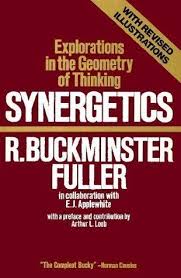
 I was surprised to discover recently in the book “Synergetics” a scheme which bears great resemblance to my “algorithm for intelligence”. Buckminster Fuller (hereinafter called “BF”), the author of “Synergetics” describes a very useful way how we apprehend the world and come to an understanding thereof, which he names the “Geometry of thinking”.


And not only are these notions of BF useful for our understanding of the outside and inside world, BFs notions could actually be implemented in artificial general intelligence.
....
More of this chapter can be found in my next book, which I have submitted for publication.

Thursday, 7 April 2016

Panpsychic Pancomputationalism as framework to build a T.O.E


“Autopoietic reality cell sensing with a digital output called existence” or “How consciousness autopoietically creates a digital reality”.

In contemporary physics the last years a new field has been developing under the name “digital physics”. The premise at the base of this theoretical perspective is that the universe is computable and a manifestation of information. Deep in the equations of supersymmetry of string theory, the physicist James Gates found what is essentially “computer code”. The concept of entropic gravity by the physicist Erik Verlinde and the holographic principle of the physicist van ‘t Hooft both concur with the notion that the physical universe is made of information, of which energy and matter are merely manifestations. Perhaps the most famous article in this theoretical field is the “It from Bit” article by the physicist J.A. Wheeler.

As an extrapolation from these theories has come the suspicion that the universe might actually itself be a computer and that we might in fact live in a computer simulation. The vast majority of proponents of this theoretical perspective think that ultimately existence is fully deterministic.

Yet a convincing Theory of Everything based on digital physics, which would also be able to account to the presence of consciousness in this universe has not seen the daylight yet. In fact the very understanding of consciousness remains an elusive topic and is often called the “hard problem”. Within the materialistic paradigm which is predominant among scientists, including most digital physicists, the problem of explaining consciousness is usually dismissed as non-existent, consciousness being considered as a mere emergent effect that arises if the system reaches sufficient complexity.

In addition to consciousness as a phenomenon without explanation in the digital physics framework, in physics at the quantum level we encounter indeterminacy, nonlocality, entanglement and the wave-particle duality. With regard to computation we encounter incomputability of certain phenomena and we are stuck with Gödel’s incompleteness theorem. Moreover physics has not been able to bring quantum physics and relativity theory under a common denominator. These phenomena and notions do not a priori seem to fit within the framework of a deterministic digital physics based pancomputational universe.

This has led to the hypothesis of certain other physicists and philosophers that consciousness may in fact lie at the base of existence. The philosopher Peter Russell proposes a paradigm shift under the name “The Primacy of Consciousness”, in which information, matter and energy are mere manifestations of consciousness. This leads to a panpsychic or hylozoic perspective on reality.

Interestingly, the URT (Unified Reality Theory) of Steven Kaufman and the CTMU (Cognitive-Theoretic Model of the Universe) by Chris Langan bring digital physics and panpsychism together in a surprising manner. Whereas these theories do not deny but rather suppose that indeed physical reality is information based and even digital, in their versions, the digital physical manifestation of relative existence is in fact embedded in a deeper fundamental level of infinite absolute existence or absolute consciousness (Kaufman) or “Unbound Telesis” (Langan). Kaufman’s and Langan’s concepts are strikingly similar but use a quite a different language making it prima facie difficult to see the resemblances.

In my quest for an all-encompassing “Theory of Everything” that includes consciousness, I have not been convinced by the materialistic scientific paradigm, but the alternative in the form of religion or esotericism has not been very appealing either. The more refreshing to me has been perspective that Langan and Kaufman offer, which unifies physics and metaphysics, quantum physics and relativity theory, determinism and indeterminacy, gravity and electromagnetism and information, mass and energy. In order to also fully unify panpsychism and pancomputationalism, I have further enriched my own interpretation of their work with some additional concepts, which will become evident in the course of this essay. This leads to a hypothetical framework of understanding, which –it is true- is still speculative, but which allows me to have a hunch how existence could possibly function without having to resort to absurd, esoteric, spooky, magical explanations or many-worlds interpretations.

In order to demonstrate how this is achieved, I will have to elaborate a bit more on Kaufman’s URT. I choose not to dive into the work of Langan, because despite its conceptual merits, it is bursting with prima facie incomprehensible neologisms.
...
More of this chapter in my next book, which I have submitted for publication.