Showing posts with label Vedas. Show all posts

Friday, 29 April 2016

Patentological Strategies towards a Fuller Understanding of a Geometry for Artificial Thought


In order to deal with the vast input of signals from the world around us by evolution we have developed the process of thinking. Thinking is a process of putting aside irrelevancies, so that we can focus on what is really important. Phenomena which are too big or too small are filtered out to give a so-called “considerable set” of information for our consideration. Hence per definition and by nature we deal with incomplete information, so that we can never grasp the complete truth of a phenomenon mentally.


In order to be able to filter out the relevancies, we have developed different kinds of sieves in the form of “schemes” to organise information in chunks which are easy to swallow.


Historically, mankind has tried to make classification schemes based on the elementary substance nature of objects, from gross to more subtle in the form of earth, water, fir, air and ether and based on our corresponding senses, smell, taste, sight, feeling and hearing. In the Vedic tradition Indian classifications add to this fivefold division Mind (Manas), Intellect (Buddhi) and Ego (Ahamkara), resulting in an eightfold division. As we also distinguish 8 tones in a scale and 8 colours in the rainbow, often mention is made of “octaves of existence”.


Philosophers have thought a great deal about schemes. We know the dialectics from Hegel, in which a thesis is followed and opposed by an antithesis, the tension of which is resolved in a synthesis accommodating elements of both and transcending the polarities.


In more modern times we also find trialectics and quadralectics. The Quadralectic system is strongly based on architectural and sociological notions of how a group of people orient in the search for a settlement (orientation), settle (determination), defend their settlement (urbanisation) and develop into an integrated society (politeia).


Aristotle also applied a fourfold division in his analysis of purposes (entelechia), which can be final, formal, material or efficient.


Even in the Vedic tradition we find in Patanjali’s Yoga sutras a fourfold scheme to apprehend the world: Visesha considers the specific objects one by one, in Avisesha via induction universal properties of a class are assessed, Linga abstracts a phenomenon to an articulated image or glyph and Alinga transcends the differences between the phenomena by their reductive sameness. Besides that he proposes an eightfold system, the Asthanga Yoga, to explore consciousness.


In my book Technovedanta I proposed a 7-step algorithm of intelligence, which is basically twice a fourfold process, but in which I declared the fourth state of the first set to be the first state of the second set after a metasystem transition. This can easily be extended into an eightfold octave scheme by including the metasystem transition itself as a state.


 I was surprised to discover recently in the book “Synergetics” a scheme which bears great resemblance to my “algorithm for intelligence”. Buckminster Fuller (hereinafter called “BF”), the author of “Synergetics” describes a very useful way how we apprehend the world and come to an understanding thereof, which he names the “Geometry of thinking”.
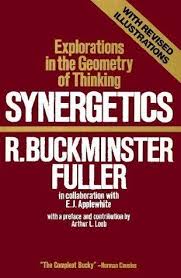


And not only are these notions of BF useful for our understanding of the outside and inside world, BFs notions could actually be implemented in artificial general intelligence.
....
More of this chapter can be found in my next book, which I have submitted for publication.

Sunday, 24 April 2016

Mahakala's Quantime and the frame-rate of the Universe


Time is a difficult concept which scientists and philosophers have been unable to properly define and understand. As a result there are no technological applications known, which really involve some manipulation of time. In our quest of knowledge and mastery of nature, it is therefore indispensable that we arrive at a true knowledge of time, which will be confirmed by our ability to technologically manipulate it

The approach in this essay is explorative and speculative. Whereas I am not a fan of speculation, as by itself it will not lead us to knowledge, it is however an essential tool to come up with a plurality of hypotheses to account for a phenomenon, which hypotheses can be verified or falsified. If more than one hypothesis remains after verification, usually we will choose the hypothesis with the least number of assumptions. This principle is known as Occam’s razor, which is an intuitive but unproven principle.

In ancient times Time was usually associated with the periodicity of a natural phenomenon such as tides, seasons or the movement of celestial bodies. Time has been associated with movement or with change in general. In recent times, the arrow of Time from past via present to future, which as of yet seems to be irreversible, has been connected to the notion of entropy: Time can only progress in the direction of an overall increase of chaos or increasing entropy: This is known as the second law of thermodynamics.

Einstein has made major contributions to our grasp of the notion of time by showing that time is relative and can be dilated if the speed at which we move approaches the speed of light. The speed of light has thus far been found to be an absolute limit to speed and when a photon travels at this speed -from the perspective of the photon- time is said to stand still. This is a consequence of Einstein’s theory of special relativity.

Einstein’s general theory of relativity goes a bit further and combines space and time into a so-called four dimensional “space-time continuum”. A continuum, because nobody has ever been able to find discrete units of space, time or space-time.

Yet there are alternative theories, which equally well account for the speed of light as a limit to speed and which are functionally equivalent to Einstein’s theory of special relativity, albeit based on different concepts:
One of these is the MDT (Moving Dimensions Theory) of Elliot McGucken. Space-time itself is expanding at the constant rate of light speed. Langan’s “conspansion” is a variant thereof in which all objects are shrinking at the constant rate of light speed, whereas space itself remains unaltered.

In my panpsychic pancomputationalism T.O.E. I have relied heavily on the work of Steven Kaufman ("Unified Reality Theory"or URT), who describes space as a fabric of “reality” cells. The reality cells themselves are nothing more than consciousness forming a first relation with itself. The cells can have an energetic content or not, turning them into a kind of computational digit. Kaufman calls such an energetic content “distortion content” and this distortion content propagates through the reality cell or space matrix in a periodic manner creating a “period of content exchange”, which Kaufman equates with the speed of light. Time in Kaufman’s model is merely a measure of the periodicity of what he calls “compound processes”. When energetic content (or photonic entities if you wish) encounter each other, they start to attract each other due to their mutual attractive distortions radiating in all directions. Thus they start to turn around each other thereby forming “matter”, which is nothing more than a second order relationship of consciousness to itself.


In this view time is more of an emergent property resulting from the compounded dynamics of multiple energy content entities propagating through the energy matrix in compound processes called matter. Without matter there is no time in Kaufman’s model.

On the other hand, since the reality cells can function as a computational digit, which conveys information, I have argued that Kaufman’s theory is essentially a form of pancomputationalism. Since in Kaufman’s model every energetic relation is an expression of consciousness, I also indicated that Kaufman’s theory is a panpsychic theory, leading to the unusual terminology “panpsychic pancomputationalism”.
...
More of this chapter in my next book, which I have submitted for publication.