Dear readers, I proudly announce my new book: "The Cybernetics and Mathematics of Consciousness" in the series "Bridging Science and Spirituality". If you are not convinced by the idea of reductive materialists, that consciousness magically emerges from complexity in material structures or processes or if you are not satisfied with the viewpoint of idealists that matter is a mere thought form, then the present hypothesis may be something for you. This is however a popular science book, so don't expect to be drowned in formulas and equations.
In this collection of Capita Selecta from my previous books, I will address the cybernetic dynamics of consciousness. Starting from the premise that Consciousness is the Ontological Primitive, I will propose mechanisms which may explain how a digital mathematical and material existence can be generated.
Digging into Category Theory, Computational Simulacra and Quantum Computing, I will explore the mechanics of self-sustaining self-referential feedback loops as the Modus Operandi of Consciousness.
Let's dive in the vortex of kaleidoscopic reflections, the wormhole of a dazzling "mise-en abyme" of recursiveness and the rollercoaster of the quantum non-locality. Explore the map which is the territory simultaneously by drawing your map of maps. Discover the non-dual bridge closing the gap between Science and Spirituality.
Good morning ladies and gentlemen, welcome to my presentation about the topic "From Information Theory to a Theory of Everything". For those who don't know me yet, my name is Antonin Tuynman. I've been working here for 18 years as an examiner in Biotechnology in the field of clinical diagnostics.
This talk is the sequel of my previous talk on Epistemology I gave in September. As I told you before these talks reflect some essential parts from my books about "Transcendental Metaphysics" and "Is Reality a Simulation?, Anthology". The first one I wrote myself alone, the other I edited and co-authored.
In my previous talk I showed you how even the scientific method based on empirical observations leaves loopholes in our knowledge and appears to lead only to relative knowledge. I promised you, that in this talk I'd explore whether we can find a more solid foundation for knowledge.
I'll try to show you that such a foundation might be found in Information Theory, which if combined with notions from String or M-theory may one day lead to a so-called theory of everything, as they call it in physics. But I will also address the so-called hard problem of consciousness, which no theory has been able to address adequately up to date. Because a "Theory of Everything" as the name suggests, should be more than a theory, which can unify gravity, nuclear forces and electromagnetism, it should also be able to account for the phenomenon of consciousness or sentience.
This is certainly important in the framework of this talk, which is looking for solid foundations of knowledge, because if we know anything, it is because we can be conscious of it. As long as information is subconscious, we haven't really realized it as knowledge, because we are not conscious of it.
What is most fundamental in the Universe? For many centuries philosophers and scientists thought it was matter. Democritus said in the 5th century BC: "Nothing exists except atoms and empty space, the rest is opinion."
However the advent of Einstein's E=mc2 equation technologically implemented in nuclear physics technology, showed that matter can be transformed into more subtle forms of existence, such as electromagnetic radiation, which we can harvest to do work. Energy might be more fundamental than matter it seemed.
Wi-Fi technology also shows that information can indeed be transmitted in the form of electromagnetic radiation without a material carrier. But there is an interesting word here: "Information".
The physicist John Wheeler suggested that information might be more fundamental than even energy in his famous article called "It from Bit". This might be a very useful piste to explore, especially in the framework of our "hard problem of consciousness", because the neuroscientist Giulio Tononi suggests that consciousness involves the integration of information. Maybe we're on to something that might unify consciousness with physics.
What is Information? To us it is some kind of message which meaning, something that can form the answer to a question. It resolves an uncertainty. But also I say "to us", because as you will see, computer scientists think differently about this.
If someone wishes to let us know something -and remember, we're also looking for the foundations of knowledge- he encodes this in words, in symbols or in numbers; and if we have the key to decode this information, because we know a language, because we can read etc. This is supposed to evoke in us a similar feeling as the person who send the message intended us to have. In fact, language, words, symbols, numbers are all encoding systems to transmit some kind of meaning. It assumes that we all use the same dictionary, the same set of definitions. Meaning hence transmits concepts or representations of physical facts or representations of feelings, which on the one hand have are a kind of dry ontological descriptive list of features of the concepts and on the other hand imply a more juicy feeling.
For us, information needs encoding and decoding, which appears to require a kind of intelligence, a kind of conscious or sentient act. This goes beyond the human mental realm. Animals can also signal information to each other. Plants can communicate with each other via an underground network of mycelium via their roots. Cells can signal each other via hormones and involve internal intricate cell signalling pathways. It even goes further down to levels of existence which we normally consider devoid of awareness: DNA encodes information, which can be further transmitted and encoded in RNA and decoded in the synthesis of a peptide or protein. Is this cellular machinery or biocomputer completely dead or is it sentient in a certain way?
It seems odd to us to suppose that a cell understands what it is doing, but given its excellent results in its homeostasis, at least from the appearance it seems to transcend the realm of a mere clockwork: The reactions of a cell can be versatile and heavily subject and responsive to emotive states of the organism: If we are depressed or troubled, we can develop all kinds of disorders and if we feel good, this is usually accompanied by an excellent health at the cellular level. DNA and RNA btw are very simple quaternary computers with only four digits: ACG and T.
The simplest information encoding system however is binary and has only two states. We represent these usually as 0 and 1, but in a computer no literal zeroes and ones are present in the electronics. Rather they are two states representing a voltage difference on a chip. You could also make a binary computer in which the ones are light pulses and the zeroes the absence thereof.
Information doesn't care about the type of carrier that encodes the information. You can encode it in smoke signals, Morse, in telegraph style, music, symbols, sounds, light pulses, because information is so-called "substrate-independent". That means it is independent of the type of substrate, but you do need a carrier, even if that is a form of radiation. Therefore, even information is not entirely independent from physicality, but perhaps it is one of the best examples of what we know what could qualify as metaphysical. It is dependent on the physical in a sense and yet transcends physicality because it is independent from the type of physicality.
Now computer scientists went a step further. "Forget about meaning", said Claude Shannon in 1949 when he presented his information theory.
For Shannon and the computer scientists after him, Information is a measure of predictability. If a string of digits has a repetitive pattern such as 10101010101010...and continuing, it does not contain much information. In fact it can be compressed in the very simple algorithm "1,0, repeat the previous digits". The more complex a number, the less compressible and the more information it can contain. This is because Shannon wanted to be able to quantify information and from this he could develop his famous equation. Here it would seem that information can exist without meaning and simply reflects the degree of pattern present.
But physicists have recently been discovering that many processes and phenomena in nature behave as if they are the result of some kind of binary coding. Not only Wheeler, but for instance the Dutch physicist Verlinde showed that the laws of gravity can be deduced mathematically if we cover a sphere with ones and zeroes. Edward Fredkin coined the term "Digital physics" and "digital philosophy".
Zuse, Wolfram, Tegmark, von Weizsäcker, Zizzi, Lloyd, Kaufman and 't Hooft are a number of prominent physicists in this current. It appears that the laws of physics can de deduced mathematically from the interplay between geometry and digitality. Buried deeply in the equations of String theory and its successor M/Brane theory - which is the most promising candidate for a theory of everything and which derives fully from mathematics- the physicist James Gates discovered what is essentially an "error correcting computer code".
Maybe you recall from my previous talk that I said "...and even the premises of a deduction have ultimately been gathered by inductive empirical observations". But I didn't tell you the exception: "Except for deductions in mathematics". But here we have something interesting: If the laws of physics can be deduced from pure mathematics, from the interplay between geometry and digitality, we might have a much more solid foundation for knowledge.
But there is a caveat here: The "If" is still a big "if", because what we're doing here is a bit like an abductive reasoning: Because the grass is wet, it does not necessarily mean that it has rained. Because some of the laws of physics can be deduced from mathematics, does not necessarily mean that our universe was created by a mathematician or that we are living in a computer simulation. But as the evidence is increasing, such speculations become more and more appealing. The question is then "Can information exist without having been encoded by something external to it ?" Because if it can't, perhaps indeed we have been simulated in a computer of a higher level of reality and if it can, there is no need for such an interpretation.
Let's dig a bit deeper into the notion of information as the most foundational ground of existence.
Can anything exist without information at all? (Information here in the broader sense of computer science).
Imagine we start from a complete nothingness. Then in order for something to exist, it must stand out from this otherwise homogeneous background; it must create a difference.
In physics there is the so-called Casimir experiment, which shows that from a vacuum (where the only things there as far as we know are electromagnetic waves), spontaneously subatomic particles like electrons can form.
Now waves can only build something which stands out from the background if an interesting interference pattern occurs.
If a stable and detectable form of a wave is formed, which we call a so-called "standing wave". In string theory, in analogy to what happens on a string of a music instrument when you here a pure tone, standing waves are formed and form the subatomic particles.
That is, if exactly a whole number of half waves fits the entire length of the string or if it is circular, the entire length of the circle: if not the interference of the wave with itself is destructive. An electron is an example of such a three dimensional standing wave. In fact the wave is looped back to itself.
This reminds me of the so-called Ouroboros: The alchemical symbol for the circular repetitive nature of existence and of infinity, but also of "consciousness": The Snake gets to know itself by biting its tail.
The subatomic particles, which ultimately make up the material part of entire tangible world, all can be considered to represent a pattern of information; numbers encoded in their wave patterns and geometries. And the non-material radiation can only have a meaningful existence if patterns and hence information can be found in there.
In many religions it is believed that a God exists who stands completely outside the physical world. To me it is difficult if not impossible to see how anything can exist outside the realm of information. If anything exists, it implies per definition some informational content, otherwise it cannot be discriminated from nothing.
But what about consciousness? When I was young I liked reading comics. And in one of these comics there was a people called the Eternauts: they had pierced all the secrets of matter and almost all the secrets of the soul. In Hinduism the soul is often equated with consciousness.
It made me think: What if the secrets of matter are the secrets of the soul/consciousness/sentience?
In a certain way, consciousness or at least sentience is also a self-reinforcing feedback loop: self-reflective and self-referential. Philosophers and mystics have claimed this throughout the ages. Douglas Hofstädter calls it a "strange loop", like the two hands of Escher, which draw eachother into existence.
For instance: You see an object and you brain identifies it, because it fits in a pattern which is already there: Just like the wave, the representation of the object loops into its own form in the mind and thus you become aware of it. Moreover, you can become aware of being aware of the object and you can become further aware of that awareness as well: It's a kind of self-reinforcing feedback loop which increases your presence.
What if consciousness or its more primitive form sentience arise as a consequence of self-sustaining, self-reinforcing feedback-loops? What if self-sustaining, self-reinforcing feedback-loops are a hallmark of consciousness or at least sentience? Then perhaps consciousness is an inherent characteristic of all particles that make up reality as well. And this would lead to the so-called notion of "Panpsychism".
I don't mean that the chair you're sitting on is aware of being a chair, but in the sense atoms and molecules can sense their environment by interacting with the vibrations of other atoms and molecules.
Is it really strange to suppose that matter in a very primitive form might have a minute form of consciousness or at least sentience? Well, there is an experiment called the double-slit experiment in physics, which suggests that the observer influences the result.
In this experiment particles, like photons are fired individually at a screen but have to pass through a slit to reach the screen. Except for the fact that there are two slits next to each other. What you would expect from normal optics is that you would get two zones on the screen extended from the trajectory of the where the screen (e.g. a photographic plate) behind the slit. Except that you don't. You get an interference pattern as if the particles behave like waves, which went through both slits simultaneously. Even if the particle is fired one by one and even if the particle is material, such as an electron.
But what is really staggering is that if you observe at the slit, you do get the expected two zone pattern! This might imply that the particles actually sense that you are observing them and change their behaviour accordingly. The subjective influence appears to change reality so that we can at least question the notion of an objective reality that exists independent from each of us.
More interestingly in an experiment by Dean Radin when people were asked to meditate on the slits while such an experiment went on in an adjacent room, they could also in a statistically significant manner disturb the normally expected interference pattern. Also random number generators, which are computational devices, dependent for instance on radioactive decay generate statistically less randomness (and hence more pattern) when emotionally disturbing events occur, such as 9/11.
These observations suggest that consciousness/sentience and matter are of the same nature or at least have a common medium of expression.
Again I repeat my caveat however; these inferences are speculative and the grass is not necessarily wet because it has rained.
But if we continue in this speculation, we have now the following elements:
Anything that exists as a detectable entity is a standing wave or an aggregate thereof.
A self-sustaining feedback loop may be the hallmark of consciousness/ sentience and maybe inherent in matter.
Information may be one of the most foundational concepts that build reality, however it cannot exist independent of a physical carrier, which must at least involve a form of radiation.
Now wherever we look in reality, information appears to be processed, not only at our human level, but also at the cellular level and even and the molecular, atomic and subatomic levels: Whenever particles interact with each other and exchange energy, their informational content changes. This appear to happen according to defined laws, which appear to be like a code processing the information. Whenever information is integrated, read or decoded, this is a kind of feedback loop and may involve consciousness/sentience. Maybe reality as a whole is also a kind of self-processing self-referencing integrating informational feedback loop and code.
Is this an idiot idea? Well, there is at least one known representative of such a notion in existence: the self-splicing RNA molecule:
This molecule is a code, which can fold back on itself and excise parts from itself. It is the most primitive life encoding molecule, the precursor of DNA, which also up to date plays an extremely important role in our cells. This molecule is like the Ouroboros: the snake that bits its own tail. It recognises parts of itself; senses these and then acts on these.
It reminds me of a tale by the Spanish writer Borges called "Del rigor en la ciencia", where there was a society in which the science of cartography had become so accurate that they made a 1:1 map of the country; a map of the same size as the country. RNA transcends even that concept: Because here the map is the territory simultaneously! It is a code that acts on itself. It is a self-processing sentient computer. Just like reality as a whole might be.
Again I repeat, this is a hypothesis; the evidence is only circumstantial. But it has the beauty that it can account for consciousness and a digitally encoded reality at the same time. If it is not the truth, at least it is an elegant artistic fantasy.
If reality as a whole is also a self- processing sentient computer, we arrive at the crazy subtitle of my book: (TMPP) Transcendental Metaphysics of Pancomputational Pansychism. Reality is then not a traditional computer simulation, which would lead to the possibility of infinite regress (because our makers could live themselves in a simulation and so on and it would not be clear where "ground reality" was), but an ongoing self-simulating self-encoding and decoding entity. This resolves our problem of the question whether information can exist without having been encoded by something external to it. Reality can exist as a code which both transcends and yet inhabits the world it creates, which is essentially physical yet can process information independent of the type of carrier and be metaphysical in that sense. A system which is ontic and epistemic at the same time. A system which incorporates and embodies itself by self-reference.
A bridge between the spiritual world of consciousness and the physical world of science. If you want to call that God, be my guest.
Most of the posts in this blog have been transformed into chapters of my next book. I have taken out the bulk of each chapter, so that what is left in the posts is now a kind of teaser. The book also contains additional chapters. I have submitted the book for publication, but I am still waiting for approval.
In the meantime, to tickle your curiosity, here is a teaser for the new book:
"Have
you ever read a book, which logically shows where logic is absurd? A book,
which scientifically shows where science fails? A meta-philosophy, which shows
where philosophy is useless?
Welcome
to the book of books. A Clavicula to open the gates of Hell and Heaven to
summon the forces of Mind and Matter. A quest into the deepest realm, where
reality and imagination fade into each other like pictorial values.
A
journey into the Highest Transcendence, Consciousness.
The
final frontier.
These
are the voyages of the Epistemonauts. Their ongoing mission:
To
seek out the Magick of Technology and the Technology of Magick, to boldly go
where no one has gone before, where the grand Union of all possible
perspectives and the sole true Theory of Everything lies:
“Everything
is hereby incorporated by reference.”
From
the primordial Sense to the scattered kaleidoscopic reverberations in the Hall
of Mirrors; the octaves and scales of Ouroboric existence, the mighty worm of
digital virtualisation.
This
is my gift to you: To free you from any belief system, to free you from the
chains of your self-inflicted prison of Mind. Fear not to be left in the
agnostic Limbo, even if I won't lead you to your Gods; instead I will show you
the Technology, which one day will make a God of you.
Meet
me at the junction where Vedic and Buddhist spirituality join Science, and I
will show you what lies beyond the Technological Singularity."
In order to deal with the vast input of signals from the
world around us by evolution we have developed the process of thinking.
Thinking is a process of putting aside irrelevancies, so that we can focus on
what is really important. Phenomena which are too big or too small are filtered
out to give a so-called “considerable set” of information for our
consideration. Hence per definition and by nature we deal with incomplete
information, so that we can never grasp the complete truth of a phenomenon
mentally.
In order to be able to filter out the relevancies, we have
developed different kinds of sieves in the form of “schemes” to organise
information in chunks which are easy to swallow.
Historically, mankind has tried to make classification
schemes based on the elementary substance nature of objects, from gross to more
subtle in the form of earth, water, fir, air and ether and based on our corresponding
senses, smell, taste, sight, feeling and hearing. In the Vedic tradition Indian
classifications add to this fivefold division Mind (Manas), Intellect (Buddhi)
and Ego (Ahamkara), resulting in an eightfold division. As we also distinguish
8 tones in a scale and 8 colours in the rainbow, often mention is made of
“octaves of existence”.
Philosophers have thought a great deal about schemes. We
know the dialectics from Hegel, in which a thesis is followed and opposed by an
antithesis, the tension of which is resolved in a synthesis accommodating
elements of both and transcending the polarities.
In more modern times we also find trialectics and quadralectics.
The Quadralectic system is strongly based on architectural and sociological
notions of how a group of people orient in the search for a settlement
(orientation), settle (determination), defend their settlement (urbanisation) and
develop into an integrated society (politeia).
Aristotle also applied a fourfold division in his analysis
of purposes (entelechia), which can be final, formal, material or efficient.
Even in the Vedic tradition we find in Patanjali’s Yoga
sutras a fourfold scheme to apprehend the world: Visesha considers the specific
objects one by one, in Avisesha via induction universal properties of a class
are assessed, Linga abstracts a phenomenon to an articulated image or glyph and
Alinga transcends the differences between the phenomena by their reductive
sameness. Besides that he proposes an eightfold system, the Asthanga Yoga, to
explore consciousness.
In my book Technovedanta I proposed a 7-step algorithm of
intelligence, which is basically twice a fourfold process, but in which I
declared the fourth state of the first set to be the first state of the second
set after a metasystem transition. This can easily be extended into an
eightfold octave scheme by including the metasystem transition itself as a
state.
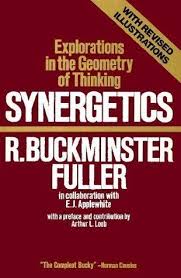
I was surprised to discover recently in the book “Synergetics”
a scheme which bears great resemblance to my “algorithm for intelligence”.
Buckminster Fuller (hereinafter called “BF”), the author of “Synergetics”
describes a very useful way how we apprehend the world and come to an
understanding thereof, which he names the “Geometry of thinking”.
And not only are these notions of BF useful for our understanding
of the outside and inside world, BFs notions could actually be implemented in
artificial general intelligence. .... More of this chapter can be found in my next book, which I have submitted for publication.
In 1965 Greg Hill ( Malaclypse the Younger) with Kerry
Wendell Thornley (Lord Omar Khayyam Ravenhurst published the"Principia Discordia or How The West Was
Lost". The Magnum Opiate of Malaclypse the Younger, Wherein Is Explained
Absolutely Everything Worth Knowing About Absolutely Anything.
An ambitious and humourful title.
As I claim to include Everything in my Technovedas, I cannot leave out this book,
which is therefore incorporated by reference.
Discordianism puts everything upside down. In fact it is the religion ofperspectivism:
“All affirmations are true in some sense, false in some sense, meaningless in some sense, true and
false in some sense, true and meaningless in some sense, false and meaningless in some sense, and true and false and meaningless in some sense.“
It is useful to get familiar with some of the concepts of
Discordianism, in order to be able to even transcend this paradigm, which is a
transcending paradigm itself.
“... HERE FOLLOWS SOME PSYCHO-METAPHYSICS.
If you are not hot for philosophy, best just to
skip it.
The Aneristic Principle is that of APPARENT ORDER;
the Eristic
Principle is that of APPARENT DISORDER. Both order and disorder are man made concepts
and are artificial divisions of PURE CHAOS, which is a level deeperthat is the level of distinction
making.
With our concept making apparatus called
"mind" we look at reality through the ideas-about-reality which our
cultures give us. The ideas-about-reality are mistakenly labeled
"reality" and unenlightened people are forever perplexed by the fact
that other people, especially other cultures, see "reality"
differently. It is only the ideas-about-reality which differ. Real (capital-T True) reality is a level
deeper that is the
level of
concept.
We look at the world through windows on which have
been drawn grids (concepts). Different
philosophies use different grids. A culture is a group of people with
rather similar grids. Through a window we view chaos, and relate it to the
points on our grid, and thereby understand it. The ORDER is in the GRID. That
is the Aneristic Principle.
Western philosophy is traditionally concerned with
contrasting one grid with another grid, and amending grids in hopes of finding
a perfect one that will account for all reality and will, hence, (say
unenlightened westerners) be True. This is illusory; it is what we Erisians
call the ANERISTIC ILLUSION. Some grids can be more useful than others, some
more beautiful than others, some more pleasant than others, etc., but none can
be more True than any other.
DISORDER is simply unrelated information viewed
through some particular grid. But, like
"relation", no-relation is a concept. Male, like female, is an
idea about sex. To say that male-ness is "absence of female-ness", or
vice versa, is a matter of definition and metaphysically arbitrary. The artificial concept of no-relation is
the ERISTIC PRINCIPLE.
The
belief that "order is true" and disorder is false or somehow wrong,
is the Aneristic Illusion. To say the same of disorder, is the ERISTIC
ILLUSION.
The point is that (little-t) truth is a matter of
definition relative to the grid one is using at the moment, and that
(capital-T) Truth, metaphysical reality, is irrelevant to grids entirely. Pick
a grid, and through it some chaos appears ordered and some appears disordered.
Pick another grid, and the same chaos will appear differently ordered and disordered.
Reality is the original Rorschach. (Note by me: the
Rorschach inkblot test, the Rorschach technique, or simply the inkblot
test) is a psychological test in which subjects' perceptions of inkblots
are recorded and then analyzed using psychological interpretation)
Verily! So much for all that.
...
Which Is Real?
Do these 5 pebbles REALLY form a pentagon?
Those biased by the Aneristic Illusion would say yes. Those biased by the
Eristic Illusion would say no. Criss-cross them and it is a star. An Illuminated Mind can see all of these, yet he does not insist that any
one is really true, or that none at all is true. Stars, and pentagons, and
disorder are all his creations and he may do with them as he wishes. Indeed,
even so the concept of number 5.
The real reality is there, but everything you KNOW about "it" is in
your mind and yours to do with as you like. Conceptualization is art, and YOU
ARE THE ARTIST. Conviction causes convicts.
...
The words
of the Foolish and those of the Wise Are not far apart in Discordian Eyes.
(HBT; The Book of Advise, 2:1)
The PODGE of the Sacred Chao is symbolized as The
Golden Apple of Discordia,
which represents the Eristic Principle of Disorder.
The writing on it,
"KALLISTI" is Greek for "TO THE
PRETTIEST ONE" and refers to an old myth about
The Goddess. But the Greeks had only a limited
understanding of Disorder, and
thought it to be a negative principle.
The Pentagon represents the Aneristic Principle of
Order and symbolizes the HODGE. The Pentagon has several references; for one,,
it can be taken to represent geometry, one of the earliest studies of formal
order to reach elaborate development;* for another, it specifically accords
with THE LAW OF FIVES.
THE TRUTH IS FIVE BUT MEN HAVE ONLY ONE NAME FOR
IT.
-Patamunzo
Lingananda
It is also the shape of the United States Military
Headquarters, the Pentagon Building, a most pregnant manifestation of
straightjacket order resting on a firm foundation of chaos and constantly erupting
into dazzling disorder; and this building is one of our more cherished Erisian
Shrines. Also it so happens that in times of medieval magic, the pentagon was
the generic symbol for werewolves, but this reference is not particularly
intended and it should be noted that the Erisian Movement does not discriminate
against werewolves—our membership roster is open to persons of all races,
national origins and hobbies.
...
The Law of Fives states simply that: ALL THINGS
HAPPEN IN FIVES, OR
ARE DIVISIBLE BY OR ARE MULTIPLES OF FIVE, OR ARE
SOMEHOW DIRECTLY OR
INDIRECTLY APPROPRIATE TO 5.
The
Law of Fives is never wrong.
....”
As you can see Discordianism denies all forms
of beliefs, including itself, which is a great way to demonstrate the fallacy
of logic and dualistic thinking.
The Principia Discordia is highly
self-contradictory from a logical perspective, or at least self-paradoxical.
E.g. If the Law of Five is True, this means everythingis profoundly ORDERED, but that is known as
the Aneristic Illusion. But this is the beauty of the system: it says the same
about disorder as the Eristic illusion. From the standpoint of perspectivism,
every notion is somehow right, in some persepective and somehow wrong in another
prespective: there are no absolutes here. Parts can never be fully known.
But the Absolute, the whole , the knoweris implicitly hidden in this
(anti-)philosophy, as we’ll see later.
The Symbol of the Discordian Movement are
five dots seemingly ordered in the form of a Pentagon and a Golden Apple of
Discordia with Kallisti written on it.
I share the notion of perspectivism strongly
with the Principia Discordia. Everything we name, see and try to understand by
means of our left-hemisphere is a way of logically connecting the dots, which
is not necessarily the TRUTH. It is just a perspective, there are many other
ways to connect the dots. Mind creates order out of a filtered reality. Whether
the basis of the underlying REALITY is order or chaos, is for the moment not so
important. In the phenomenal world these are but relative concepts. Just when
you are zooming in on a picture. From far away it may not have any meaning,
suddenly you start to see things in there, you start to connect dots in a
certain way, but if you look closer, you see something else etc. ad infinitum
until you arrive at pixels, but then you can go on with ma microscope and an
electron microscope and at any level you will see different things.. But it is
not so that one concept you see is wrong and the other other right: all concept
are in a sense Mind-projections depending on the granularity of observation. You
can say all notions are true in a certain way, in a certain magnification of the
lens, but they are also simultaneously false from the perspective of another
magnification level. You cannot know what is really there by Mind. Via
relations and relativism you cannot know the thing per se and in se. As Kant
would say the Noumenon. Order and
Disorder are relative concepts arising from an incomplete experience. Relativity
and incompleteness, undecideability are different aspects of the same illusion
of Mind.
.... More of this chapter in my next book, which I have submitted for publication.