On October 11 2019 my new book "The Ouroboros Code: Reality's Digital Alchemy Self-Simulation Bridging Science and Spirituality" with the foreword by Alex M.Vikoulov will be released by Ecstadelic Media Group as e-book and paperback.
Here's the blurb:
Will the abyss between mind and matter ever be bridged? How can configurations of matter ever give rise to consciousness? This is the greatest enigma that puzzles the scientific world, also known as "the hard problem". How do the objective and subjective dimensions relate to each other? It is here that scientists and spiritual seekers appear irreconcilable. Yet the number of scientists calling into question the hegemony of reductive materialism is steadily on the rise.
As Artificial Intelligence, Nanotechnology and Transhumanism make us rapidly approach the era of the Technological Singularity, the borders between the physical and the metaphysical appear to fade into oblivion, by virtue of the all-encompassing umbrella of Digital Information Technology. Indeed, to wonder whether we might be living in a kind of computer simulation has become a legitimate question.
It is exactly here that the building blocks for the bridge between science and spirituality might be found. What if our reality experience is the product of a code? Could such a code provide a subjective experience? What are the characteristics of such a code?
Embark on a mind-boggling quest into this deepest alchemical secret. Prepare yourself for a Tsunami of mind-altering concepts. Let yourself be drawn into the vortex of the Pansentience hypothesis. Learn how reality may digitally self-simulate by becoming the map and the territory simultaneously. And let yourself be seduced by Eris' apple of confusion as you bite in your own tail, discovering you are no one else than the mighty Ouroboros. Discover how Yoneda's Lemma shows us that material manifestations are mere fossils of sensing. Sail through the perilous uncharted seas of the unknown, where intelligence has not found ways yet to map safe maritime routes and routines. And examine for yourself in the light of evidence from entropy, information, algorithms and pattern recognition, whether this voyage will guide you to be wrecked in woo or to be docked in the harbor of wisdom.
This forbidden fruit is the gateway to the Eschaton, the luminous Omega Hypercomputer at the end of time. The guide to the non-dual essence of being. This is the recipe to perform the Magnum Opus. The recursive self-modifying Ouroboros code to experience the ecstasy of Kundalini's Technotranscendentalism, where All is One and we are God.
A must read for scientific spiritualists and spiritual scientists.
-Antonin Tuynman, PhD
Hereunder you'll find the Table of contents to inspire you:
Showing posts with label Artificial Intelligence. Show all posts
Monday, 7 October 2019
The Ouroboros Code: Reality's Digital Alchemy Self-Simulation Bridging Science and Spirituality
Tuesday, 2 May 2017
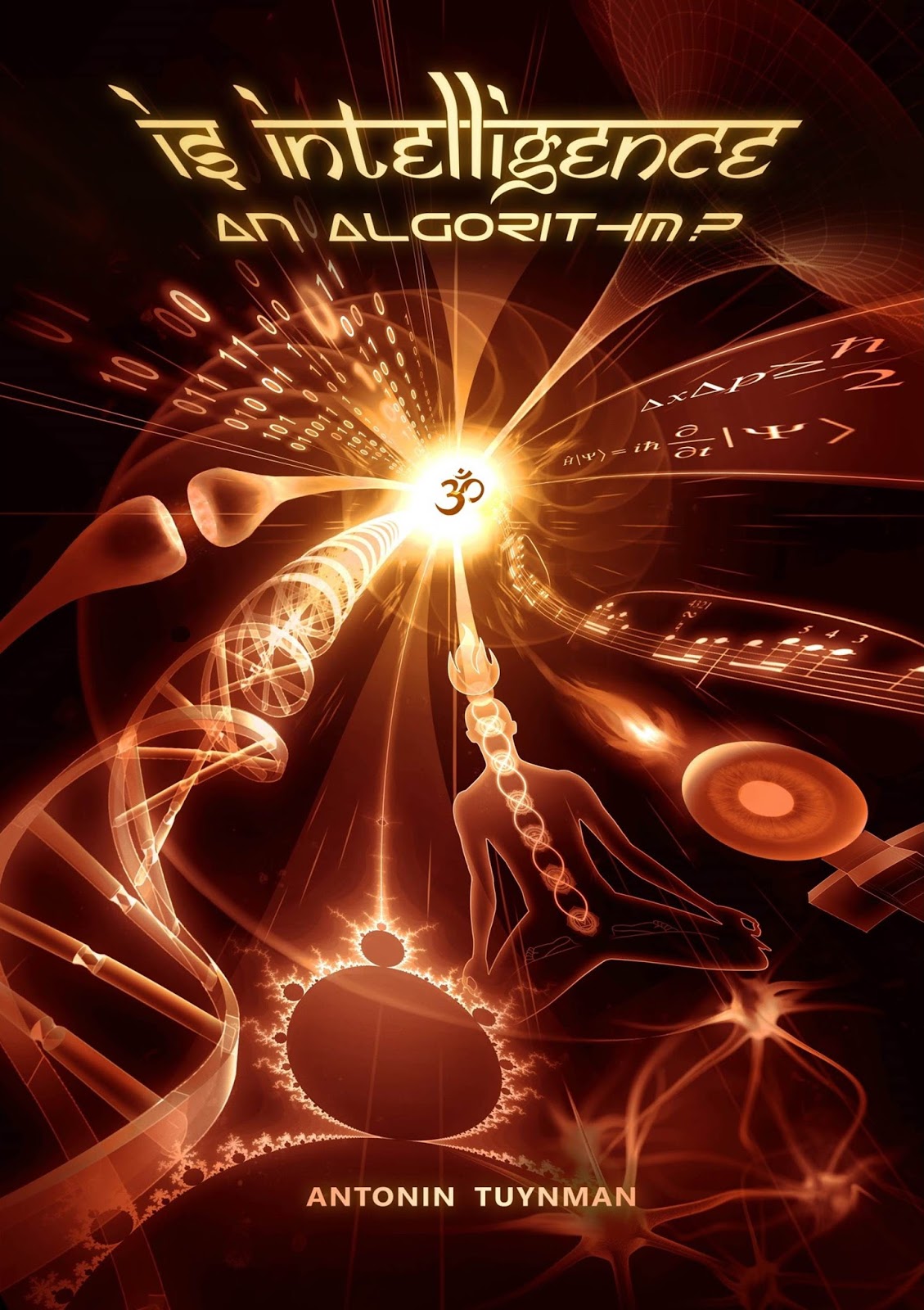
Is Intelligence an Algorithm?
My book "Is Intelligence an Algorithm?" will be published on 26-1-2018 by iff-books. This book is a must for anyone who would like to improve his/her intelligence. The book starts with an overview how in Nature evolutionary complexity is arrived at via an inherent sequence of steps, which you could call an algorithm. Then the book analyses different aspects involved in human intelligence such as (re)cognition, reasoning and problem-solving. The role of emotions and how to control them is also discussed. Three chapters are dedicated to artificial intelligence. The book concludes with the more elusive aspects of intuition.
The book is available on amazon for pre-orders:
https://www.amazon.co.uk/Intelligence-Algorithm-Antonin-Tuynman/dp/1785356704
Here is the "Marketing Blurb":
Do you wish to improve your intelligence? Then we’ll first
have to figure out what “intelligence” actually is.
Join me on a journey that starts with Nature’s ways to generate complexity. I will show you that from bacterial wisdom to the quagmire of human social interactions the same steps are followed to generate so-called “meta-system transitions”, where singleton entities organise into societies and finally into new emergent entities built there from.
In this book I will not only dissect intelligence into elements of cognition, pattern recognition, reasoning, problem-solving and diversity generation, I will also venture into the more elusive realms of emotions and intuition.
From these concepts I will provide strategies, heuristics and architectural plans to create a new generation of Artificial Intelligence. A conceptualisation of Artificial Consciousness and a blueprint for an Artificial Webmind.
And as a bonus I will provide you with tools. Tools to organise your thoughts, tools to solve any kind of problem, tools to navigate through the wild waves of our emotions.
This is the abstraction of the dissecting knife of the intellect and the great integrator of cliques allowing to spawn a plethora of novel and inventive solutions which are screened and pruned to generate an apotheosis of ever increasing complexity.
This is the book that reveals nature’s inherent simple algorithm to achieve complex goals in complex environments.
Join me on a journey that starts with Nature’s ways to generate complexity. I will show you that from bacterial wisdom to the quagmire of human social interactions the same steps are followed to generate so-called “meta-system transitions”, where singleton entities organise into societies and finally into new emergent entities built there from.
In this book I will not only dissect intelligence into elements of cognition, pattern recognition, reasoning, problem-solving and diversity generation, I will also venture into the more elusive realms of emotions and intuition.
From these concepts I will provide strategies, heuristics and architectural plans to create a new generation of Artificial Intelligence. A conceptualisation of Artificial Consciousness and a blueprint for an Artificial Webmind.
And as a bonus I will provide you with tools. Tools to organise your thoughts, tools to solve any kind of problem, tools to navigate through the wild waves of our emotions.
This is the abstraction of the dissecting knife of the intellect and the great integrator of cliques allowing to spawn a plethora of novel and inventive solutions which are screened and pruned to generate an apotheosis of ever increasing complexity.
This is the book that reveals nature’s inherent simple algorithm to achieve complex goals in complex environments.
Please visit my new website dedicated to this new book: https://www.intelligencealgorithm.com/
I will be needing reviews from people who have read the book. If you are interested in getting a "review copy" for a reduced price before the book is officially published please contact me at iconomen@gmail.com.
Friday, 29 April 2016
Patentological Strategies towards a Fuller Understanding of a Geometry for Artificial Thought
In order to deal with the vast input of signals from the world around us by evolution we have developed the process of thinking. Thinking is a process of putting aside irrelevancies, so that we can focus on what is really important. Phenomena which are too big or too small are filtered out to give a so-called “considerable set” of information for our consideration. Hence per definition and by nature we deal with incomplete information, so that we can never grasp the complete truth of a phenomenon mentally.
In order to be able to filter out the relevancies, we have
developed different kinds of sieves in the form of “schemes” to organise
information in chunks which are easy to swallow.
Historically, mankind has tried to make classification
schemes based on the elementary substance nature of objects, from gross to more
subtle in the form of earth, water, fir, air and ether and based on our corresponding
senses, smell, taste, sight, feeling and hearing. In the Vedic tradition Indian
classifications add to this fivefold division Mind (Manas), Intellect (Buddhi)
and Ego (Ahamkara), resulting in an eightfold division. As we also distinguish
8 tones in a scale and 8 colours in the rainbow, often mention is made of
“octaves of existence”.
Philosophers have thought a great deal about schemes. We
know the dialectics from Hegel, in which a thesis is followed and opposed by an
antithesis, the tension of which is resolved in a synthesis accommodating
elements of both and transcending the polarities.
In more modern times we also find trialectics and quadralectics.
The Quadralectic system is strongly based on architectural and sociological
notions of how a group of people orient in the search for a settlement
(orientation), settle (determination), defend their settlement (urbanisation) and
develop into an integrated society (politeia).
Aristotle also applied a fourfold division in his analysis
of purposes (entelechia), which can be final, formal, material or efficient.
Even in the Vedic tradition we find in Patanjali’s Yoga
sutras a fourfold scheme to apprehend the world: Visesha considers the specific
objects one by one, in Avisesha via induction universal properties of a class
are assessed, Linga abstracts a phenomenon to an articulated image or glyph and
Alinga transcends the differences between the phenomena by their reductive
sameness. Besides that he proposes an eightfold system, the Asthanga Yoga, to
explore consciousness.
In my book Technovedanta I proposed a 7-step algorithm of
intelligence, which is basically twice a fourfold process, but in which I
declared the fourth state of the first set to be the first state of the second
set after a metasystem transition. This can easily be extended into an
eightfold octave scheme by including the metasystem transition itself as a
state.
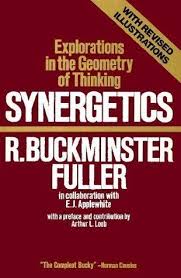
I was surprised to discover recently in the book “Synergetics”
a scheme which bears great resemblance to my “algorithm for intelligence”.
Buckminster Fuller (hereinafter called “BF”), the author of “Synergetics”
describes a very useful way how we apprehend the world and come to an
understanding thereof, which he names the “Geometry of thinking”.
And not only are these notions of BF useful for our understanding
of the outside and inside world, BFs notions could actually be implemented in
artificial general intelligence.
....
More of this chapter can be found in my next book, which I have submitted for publication.
....
More of this chapter can be found in my next book, which I have submitted for publication.
Subscribe to:
Posts (Atom)