Showing posts with label Langan. Show all posts

Thursday, 15 March 2018

"When the map becomes the territory". Recursive Self Modification: A Universal language of Reality Ontogenesis?

If I were to tell you that reality is a kind of book that is writing itself, you'd probably declare me bonkers. If I were to tell you that there are even scientists, who seriously contemplate this surreal idea in the form of a self-processing sentient language that creates reality by modifying itself, you'd probably get the hell out of my vicinity as fast as you could. The fact that I even dare to mention these unicorn fables, will probably make you put away this article at this very moment.
If you still continue reading, you might have a sense of humour or curiosity to see how people end up contemplating such rubbish. After all, language is a high-level phenomenon. Surely these people mistake the map and the territory. Or maybe you find it fascinating that someone came up with the bizarre and unrealistic idea to unify the ontic and the epistemic under one banner.
But if I tell you there are certain subtypes of a molecule called ribonucleic acid (RNA), which almost hit all the marks to qualify as real life representatives of this concept, you might be willing to lend me a listening ear. After all such a concept might have technological applications in biotech or in artificial intelligence in the form of an algorithm that can create complexity by recursive self-modification to generate a more dynamic version of the computer program called "game of life".
RNA is the nucleic acid molecule that preceded the better known nucleic acid carrier of inheritable traits called DNA in evolution. Certain viruses, proto-life forms, do not have a DNA but an RNA molecule instead. RNA is also present as an essential constituent in the cells of every life form. Nucleic acids are like a code with four symbols, which are present in the form of two pairs of complementary molecular motifs called nucleotides. They encode proteins. The code can be read by other nucleic acids that dock to the code if they have the complementary code. This can then trigger the assembly of proteins from amino acids. It can also result in the further assembly of a complementary nucleic acid strand, which is a form of copying the code. So basically nucleic acids function as a kind of cellular computer, which takes other nucleic acid molecules as input and provides proteins or nucleic acids as output.
Certain types of RNA can fold back on themselves and have stretches of their nucleotides pair, so that you get a kind of lariat form. Where did I see this before? It reminds me of the alchemical symbol of the Ouroboros, the snake that bites its own tail and thereby gets to know itself. An ancient symbol of the self-reflective nature of consciousness.
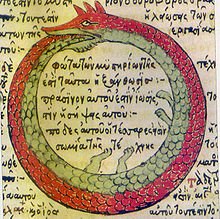
 
Image of Ouroboros
Source: upload.wikimedia.org/wikipedia/commons/thumb/7/71/Serpiente_alquimica.jpg
Now certain RNA molecules can process i.e. modify themselves when they interact with themselves. Often this results in cutting of a part of itself (self-splicing), but it can also result in extending itself. 
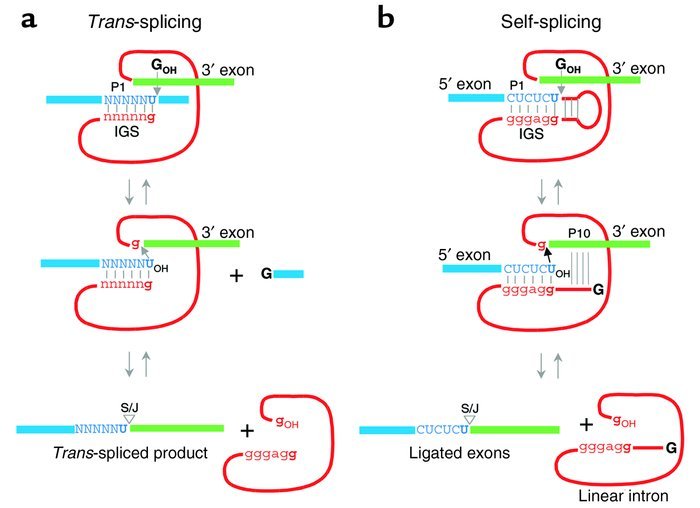
Image of self-splicing RNA
Source: dm5migu4zj3pb.cloudfront.net/manuscripts/19000/19386/medium/JCI0319386.f1.jpg
In other words, these RNA molecules constitute a kind of code or language, if you wish, that recognises and reads itself and modifies itself as a consequence thereof. 
The only aspect which a priori appears to be missing from the earlier mentioned concept of a self-processing sentient language that creates reality by modifying itself, is the "sentience" aspect. You could argue that the molecular interactions that lead to the mutual recognition of the motifs are sensed in a certain way; it is not merely the fitting of pieces of a jigsaw puzzle: electronic charges attract and repel each other and hydrogen bonds are formed. If we accept this as a form of primitive sentience, this molecule hits all the marks to qualify as an instance of the previously defined concept. When it comes to RNA maps can be territories simultaneously. So a self-processing sentient language that creates reality by modifying itself might after all not be such a surreal concept.
In the last decades some idealist-type ideas have been suggested by outsiders with respect to philosophy, who suggest that virtually everything in reality is the result of such a "Recursive Self-Modification" of a code. In view of the RNA example, perhaps they do merit our consideration, if not for philosophical reasons then at least for the potential technological relevance or as an aesthetic enrichment of the human epistome (i.e. the complete collection of all that is known in imitation of terminologies such as genome and proteome).
Many of these ideas find their origin in a branch of physics called digital physics. Not energy, but information is considered to be at the root of reality. But this introduces a problem, because information implies meaning conveyed by symbolism and requires a mind or at least consciousness to recognise or make sense of the meaning. And this brings us back to the age-old problem of the Cartesian Mind-Body dualism. So if information is at the root of the manifested reality, consciousness must somehow be present at a deeper non-manifested level.
In this essay I will show you how a number different scientists and garden-variety philosophers have come up with a suggested solution to this problem, the common denominator of which is the notion of Recursive Self-Modification. I will give an overview of a number of such contemporary "mind=reality theories", which consider reality as the product of a cognitive self-processing language. I will discuss a number of similarities between Langan’s Cognitive Theoretic Model of the Universe (CTMU), Irwin’s Code Theoretic Axiom (CTA), Kaufman’s Unified Reality Theory (URT), Tsang’s Brain Fractal Theory (BFT) and Deli’s Science of Consciousness (SoC). I will also discuss the idiosyncrasies which makes each of these theories unique. Aspects as neural networks, fractals, category theory and the Yoneda Lemma and their implication for sentience, self-reference and self-processing will be discussed. Finally, I’ll try to suggest how these different complementary frameworks can be integrated in order to evolve towards a Theory of Everything, with the ultimate aim of providing a sound metaphysical basis for physics without the usual paradoxes that arise from the underlying self-reference.
Although I do not take most of these theories seriously over their whole scope, it is neither my intent to use this essay to systematically undermine each of these theories, nor is it my intent to defend them against criticism. Rather, I'd like to review them in order to distil useful notions worthy of further exploration.
...
Interested in reading more of this chapter? The book “Is Reality a Simulation? An Anthology”, which I, Antonin Tuynman (a.k.a. Technovedanta) edited and co-authored is now available as Hardcopy and as Kindle ebook. But you can get a free pdf, if you promise me to write a review and post it on Amazon, Goodreads and Lulu. For a free pdf send an email to iconomen at gmail dot com.

Wednesday, 13 April 2016

From the technology in the Vedas to the Veda of Technology


In this blog I have defined Technovedanta as a technological meta-knowledge philosophy beyond science and religion. The underlying epistemological idea is that mental knowledge can a priori only be speculative and in order to really know that our knowledge is valid, we must be able to reduce it to practice in the form of a technological application.

You may wonder why I introduced the word “Vedanta” which refers to a collection of Vedic scriptures. What do the ancient Indian Vedas have to do with epistemology?

The reasons are manifold: Prior to this blog I wrote a book called “Technovedanta”, in which I proposed an architecture for the internet as aware network (the Awwwarenet) based on stratifications derived from the Indian philosophy of Vedanta to create a functional mimic of consciousness, quasi-consciousness. Writing this book, the investigation of nature’s fundamental primacy of consciousness led me to the hypothesis of a panpsychic theory of everything.

But my ideas continued to evolve on this topic: In this blog I deepened my T.O.E by adding a pancomputational dimension, as described in the post on panpsychic pancomputationalism. As a corollary I became interested in the topic of epistemology: What can we really know for sure and how can we be so sure that what we know is “true”. Since my philosophy was extending into the very core of epistemology and my conclusion was that true knowledge can only be confirmed by a technological application thereof, it was apt to use a terminology that combined both technology and knowledge. But I already had proposed a terminology that was fit for that concept, namely “Technovedanta”. 

The Sanskrit word “Veda” means “knowledge” as come from the root “Vid” to know. As Sanskrit is an Indo-European language, it will be no surprise that we find back this root in other Indo-European languages: In the Germanic languages Norwegian and Swedish to know is “vet”, in Dutch it is “weten”. In Slavic languages such as Slovakian it is “vediet”, in Slovenian “vedeti” and in Belarusian “viedac”.

It is important to realise that with the word Veda the Indians did not only mean the different scriptures called the Vedas, but rather the totality of all knowledge, including transcendent knowledge, which is the root of consciousness: Consciousness can only become aware of itself by knowing. At that moment when the knower realises that the only thing he can know is the content and the process of his own consciousness, knower, known and knowing merge into a oneness. In other words in a transcendent sense Veda or knower-knowing-known is a kind of synonym for consciousness.

Veda as synonym for consciousness fits my quest into the ultimate nature of being perfectly, because that’s what my book was mostly about. 

But there is more to the story; Veda is also understood as the cosmic knowledge which is more fundamental than the physical world. In fact the Indian philosophy of the written Vedas (or Vedanta as the larger body of Vedic scriptures encompassing more than the traditional four Vedas only) is a form of Idealism: what we call reality is fundamentally mental or at least immaterial. It is not consciousness that emerges from matter as in materialism, but matter that is born out of consciousness in an attempt to know itself.
...
More of this chapter in my next book, which I have submitted for publication.


Thursday, 7 April 2016

Panpsychic Pancomputationalism as framework to build a T.O.E


“Autopoietic reality cell sensing with a digital output called existence” or “How consciousness autopoietically creates a digital reality”.

In contemporary physics the last years a new field has been developing under the name “digital physics”. The premise at the base of this theoretical perspective is that the universe is computable and a manifestation of information. Deep in the equations of supersymmetry of string theory, the physicist James Gates found what is essentially “computer code”. The concept of entropic gravity by the physicist Erik Verlinde and the holographic principle of the physicist van ‘t Hooft both concur with the notion that the physical universe is made of information, of which energy and matter are merely manifestations. Perhaps the most famous article in this theoretical field is the “It from Bit” article by the physicist J.A. Wheeler.

As an extrapolation from these theories has come the suspicion that the universe might actually itself be a computer and that we might in fact live in a computer simulation. The vast majority of proponents of this theoretical perspective think that ultimately existence is fully deterministic.

Yet a convincing Theory of Everything based on digital physics, which would also be able to account to the presence of consciousness in this universe has not seen the daylight yet. In fact the very understanding of consciousness remains an elusive topic and is often called the “hard problem”. Within the materialistic paradigm which is predominant among scientists, including most digital physicists, the problem of explaining consciousness is usually dismissed as non-existent, consciousness being considered as a mere emergent effect that arises if the system reaches sufficient complexity.

In addition to consciousness as a phenomenon without explanation in the digital physics framework, in physics at the quantum level we encounter indeterminacy, nonlocality, entanglement and the wave-particle duality. With regard to computation we encounter incomputability of certain phenomena and we are stuck with Gödel’s incompleteness theorem. Moreover physics has not been able to bring quantum physics and relativity theory under a common denominator. These phenomena and notions do not a priori seem to fit within the framework of a deterministic digital physics based pancomputational universe.

This has led to the hypothesis of certain other physicists and philosophers that consciousness may in fact lie at the base of existence. The philosopher Peter Russell proposes a paradigm shift under the name “The Primacy of Consciousness”, in which information, matter and energy are mere manifestations of consciousness. This leads to a panpsychic or hylozoic perspective on reality.

Interestingly, the URT (Unified Reality Theory) of Steven Kaufman and the CTMU (Cognitive-Theoretic Model of the Universe) by Chris Langan bring digital physics and panpsychism together in a surprising manner. Whereas these theories do not deny but rather suppose that indeed physical reality is information based and even digital, in their versions, the digital physical manifestation of relative existence is in fact embedded in a deeper fundamental level of infinite absolute existence or absolute consciousness (Kaufman) or “Unbound Telesis” (Langan). Kaufman’s and Langan’s concepts are strikingly similar but use a quite a different language making it prima facie difficult to see the resemblances.

In my quest for an all-encompassing “Theory of Everything” that includes consciousness, I have not been convinced by the materialistic scientific paradigm, but the alternative in the form of religion or esotericism has not been very appealing either. The more refreshing to me has been perspective that Langan and Kaufman offer, which unifies physics and metaphysics, quantum physics and relativity theory, determinism and indeterminacy, gravity and electromagnetism and information, mass and energy. In order to also fully unify panpsychism and pancomputationalism, I have further enriched my own interpretation of their work with some additional concepts, which will become evident in the course of this essay. This leads to a hypothetical framework of understanding, which –it is true- is still speculative, but which allows me to have a hunch how existence could possibly function without having to resort to absurd, esoteric, spooky, magical explanations or many-worlds interpretations.

In order to demonstrate how this is achieved, I will have to elaborate a bit more on Kaufman’s URT. I choose not to dive into the work of Langan, because despite its conceptual merits, it is bursting with prima facie incomprehensible neologisms.
...
More of this chapter in my next book, which I have submitted for publication.

Meditation is Ontological Disambiguation


Ontologies are taxonomical lists describing phenomena in terms of Species, Categories, Attributes, Relations, Functions, Restrictions, Rules, Axioms and Events. In fact all knowledge is a form of ontology. It constitutes the mental representation of what is perceived to be an object by the filters of the senses and the mind. An ontology per definition needs at least two elements, for otherwise it has not enough elements to discriminate itself from anything else. It is therefore per definition minimally a so-called "didensity".

To know or identify a thing we use ontological categorisation. This takes place via perception of differences between phenomena leads to abstractions on a meta-level, which can be strategically used to improve the survival chances of an entity.
The very process of abstracting patterns which are grounded in a multiplicity of singleton experiences, allows us to keep the essential in our memory and discard the non-essential, thereby forgetting non-relevant information. Ideally we "learn" that a set of co-occurring essential conditions leads to an effect and we store this as a cause-effect relation, which in the future we can use to predict the outcome of a certain event or to devise a strategy to advantageously employ the benefits thereof or conversely to avoid the detrimental effects thereof.

In fact this process of abstraction or pattern recognition is what enables living creatures including us to deal with the world in a meaningful manner: When comparing to phenomena we can conclude that they belong to a similar class or category if they share a significant number of correspondences or similarities, whereas a preponderance in differences may lead us to conclude that phenomena belong to different categories. Thus we taxonomically "determine" or "identify" a species, which is called "recognition". We cognise it again, because it resonates with the ontological structure we had built in our mind.
When you meditate on an object, you also do this in the first two stages, but you also do the opposite: you look for universal unity between the ontologies you have defined and you arrive at a kind of "ontological disambiguation".

Patanjali describes this in the issues of Samprajnata Samadhi (I.17: ) in conjunction with the Stadia of Gunas: Visesha, Avisesha, Linga, Alinga which correspond with consciousness state of Vitarka, Vicara, Ananda, Asmita.

1) Visesha means special: first you identify a species with all its ontological characteristics.
2) Avisesha means universal: Then you identify the class/category to which species belongs: Abstraction. This process is looped until you arrive at 3).
3) Linga means Glyph, Symbol. You provide the Universal with an identification Tag. This is a higher abstraction above level 2); According to Vivekananda it also entails realisation as to the material of which object is made. If you loop this realisation to ever finer material sates you end up in 4).
4) Alinga without signifier. The objects fade, because you realise and experience it is all made of the same sat-chit-ananda energy-consciousness-bliss. Thus you become "one" with the object and merge at the highest level with the essence of being-experiencing-manifesting itself.

Ultimately, meditation is then doing the opposite of what is needed to survive in the external world.

This four step process is very similar to Christopher Langan's "syndiffeonic analysis" in his “Cognitive-Theoretic Model of the Universe”.
...
More of this chapter in my next book, which I have submitted for publication.

Wednesday, 6 April 2016

Supermetatautological absurditions of logic: A crash course in quantum metaphysics of the Absolute


If from the quantum foam of the Dirac sea an infinitude of parallel universes emerges, so that everything which could possible be thought and happen de facto happens somewhere sometime somehow in a given universe (whether these are real or virtual manifestations, is a matter of perspective as we will see), the answer that an ultimate quantum computer that is the multimetaverse and yet not, would give to any question is: “It depends on the point of view”. Everything is somehow true and somehow false.
Quantum mechanics is the language of the Absolute: as long as something has not been observed from a given perspective everything is still possible. The phenomenon and its mutually exclusive opposite co-exist in unity. This is ultimate monism: Advaita Vedanta, Yin and Yang, The Tao and the Tao that can be named….  Duality absolved in an absurdition superposition. Existence exists… does it really? Or is it virtual? Or is the Absolute rather an existence and non-existence superimposition. What we call reality is but a collection of  transient quantum fluctuations. If God, its multimetaverse and everything is also an ultimate quantum computer, then in order to get the right answer for a given precise situation such a quantum computer would need to be fed an infinite string of specifications, which would be impossible to provide for any entity with a limited perspective. Therefore the only answer that really makes sense coming from such a quantum computer is “It depends on the point of view”. Uncertainty, incompleteness and incomputability make that any advanced quantum computer at a certain moment will start having difficulties between generating probabilities of likelihood and spitting out oracle gibberish such as the answer is 42. The unstoppable loop (we’re caught in a Turing type halting problem called cosmosemiosis) of ever novel redefinitions of manifestations.
The absolute, the noumenon or source is everything and yet not. “And yet not” is QM par excellence. Is it 1 is it 0 is it ∞? It is Mu (and yet not). Are we dead, are we alive or is this an eternal cyberbardo? The virtualisations are an ever redefining network, a hall of mirrors with different degrees of symmetry breaking throughout the kaleidoscopically resonating octaves of existence. The cross-referencing between all the nodes in lesser or greater degrees assures a set of holological reflections. A supermetatautological system in which every thing is a metaphor or reflection of everything else. In the Absolute sense and non-sense therefore coexist. Sense is a relative perspective arising from a limited set of information: it is merely a Bayesian proximity co-occurrence. This is my theory of everything: Everything is hereby incorporated by reference. This is the psychogenic mushroom soup for experienced ayahuasqueros only.
Hakuna matata, ‘t is maar hoe ge ‘t ziet…

Everything is hereby incorporated by reference

The concept of a “Theory of Everything”, a T.O.E. is mostly known from contemporary physics, which is seeking to establish a theoretical framework to unify the physics of the very large (e.g. general relativity) with the physics of the very small (e.g. quantum mechanics).
An ambitious terminology as the Theory of Everything should not be limited to physics alone, but instead should be able to present a unifying framework for every type of knowledge, language, symbolism, yes any phenomenon. On the other hand it must be clear from the onset that a T.O.E. can never encompass completely everything that exists, as it is a descriptive referential tool. When you try to express “existence”, “the absolute”, “infinity”, “continuum” etc. in descriptive i.e. relative discrete terminologies or logical operators, you immediately impose a limitation, you limit it to and express it in terms of something it is not. In other words, the Tao that can be named is not the Tao. This T.O.E. therefore does not claim to “be” everything, but to provide a self- and cross-referential framework of understanding for every manifestation of existence that can be known. It probes the boundaries of the epistemological query. Also the phenomenological aspects of existence are not completely knowable, as we have learnt from Gödel’s incompleteness theorem, Heisenberg’s uncertainty principle and Turing’s incomputability. Perhaps it should therefore rather be called the “theory of the knowable relative aspects of existence”. But the theory will at least attempt to also provide a meta-framework for these aspects.

Fortunately, recent developments in physics are indeed developing towards a theoretical framework, which is capable of habouring any type of knowledge, including knowledge outside the technical sciences (mathematics, physics, chemistry, biology etc.), such as economics, linguistics, sociology, theology etc.
These developments all converge to a similar notion, namely that the underlying fabric of the relative aspects of existence is “Information”.

Langan describes this fabric as an autopoietic self-processing language (SPSCL), Wheeler has coined the term “It from Bit” and Verlinde has recently shown that entropic attraction as a result of informational processing can be used to derive the (Newtonian) laws of gravity.
It is not surprising that such notions surface in a society which is based on the paradigm of information technology, just as Maxwellian and Darwinian paradigms set the framework for understanding at the end of the 19th century.
But it seems that the present conceptual paradigm shift is one of a far more fundamental nature; its potentiality of embedding virtually everything is in principle infinite: All concepts can be harboured in the framework of information, as it is the ultimate framework for concepts and abstractions. It may well be the last paradigm shift of mankind, before we enter the singularity.
The present T.O.E. will be formulated on a separate page on this blog site. The posts, including the present one are the brainstorming process to come to this T.O.E.
If I can be successful in defining a T.O.E. it will be the ultimate key to heaven and hell, the Goetia and Theurgia united.
The implications of this theory go far beyond what is presently imaginable and acceptable. That what we humans hold so dearly will fall away when we’ll succeed to contemplate the infinitude of the multiverse.
After all, what it implies is that existence as we know it is just a game…
From a religious and ethical perspective this T.O.E. will a priori appear as a heresy and abomination of human thought, as this T.O.E. claims nothing less than the notion that if there is an absolute God, it also encompasses all evil and all that what we consider immoral, unethical and despicable.
This T.O.E. goes beyond duality. It is not written for human beings, who want to live happily ever after in their habitual four dimensional framework. It is written for those daring souls, who boldly go where no one has gone before, willing and capable of accepting both the magnificent and horrifying aspects of dual relative existence, of going beyond the relative concepts of morality, truth, purpose and meaning.
The technologies, which will become enabled as a result of this T.O.E. will take the human being beyond his human form, beyond his wildest dreams of interstellar travel in four dimensions. Because it will open the doors of perception to the countless parallel universes and dimensions that constitute the multiverse. Because it will make us venture beyond the imaginable by virtue of the descent into imagination.
This T.O.E. will be built on the strong panpsychic presumption: all that exists is a form of consciousness. Consciousness, as an onion with an infinite amount of layers. Consciousness, as ripples in the ocean of the cybernetic dreamtime.

Travelling into the minuscule below the Planck length or into the mega-macroscopic beyond the cosmic horizon, will become a mere downloading of an informational program to your section of consciousness.
You will be able to access any universe at any point in time by simply choosing to do so. You’ll be able to live any parallel scenario of your lifestory with different parameters. You can be who you want to be, whenever and wherever you want to. Depending on the creativity of your imagination, which will become vastly enhanced by merging or mindmelding with appropriate artificial and natural intelligences, you will access any world of choice. You will be able to morph into any form, to live a full immersion experience of any entity by simply downloading those aspects from the Akashic Record to your section of consciousness.
Don’t ye know ye are Gods? Tripping through any fractal, pink pantering in and out of dimensions, destroying demons, ruling worlds…

Welcome to a journey into you.

The relative aspects of existence are a network of relations, in which no phenomenon exists autopoietically out of itself, but is rather defined by holographic relations that make it appear to be a separate entity. It is a network of ontological references. Applying Langan’s technique of syndiffeonesis, it can be shown that every phenomenon is reductively the same. Every phenomenon is a quantum of information. In order to capture the complete set of knowable information into a model therefore the general statement “Everything is hereby incorporated by reference” is appropriate. We’ll see how we can define a framework in the coming posts.