Wednesday, 28 March 2018

Are we living in a Simulation? A historical overview


It is hard, if not impossible to determine how deep the roots of belief in the tree of virtuality reach back in the history of the human race. Certainly we did not need our Oculus Rift VR headset to come up with this idea. When did man first started to doubt the reality of the solid world around him? When did we first start to think we might be living in an illusion? 

Antiquity

The first written tradition is perhaps the allegory of the cave by Plato [1]  in his treaty "The Republic" written around 380 B.C. 
In this allegory prisoners are chained in a cave in such a way that they can only look at a wall in front of them. Behind them is a fire burning and between the fire and the prisoners is a low wall, behind which other people walk carrying objects or puppets "of men and other living things". These objects cast shadows on the wall in front of the prisoners. The sounds made by the walking people also echo from this wall, so that it seems that the shadows are making these noises. For the prisoners, who never experienced anything else these shadows are the only reality there is. In the story one man escapes. At first according to Plato he would not understand that what the prisoners see and hear are mere shadows and echoes.  Only once the escaped prisoner would find out about sunlight outside the cave and get accustomed to it, he'd be able to learn about shadows. Thus he'd start to understand the real source of the images and sounds. Thereafter he'd consider this new reality superior and "he would bless himself for the change, and pity [the other prisoners]" and would want to bring his fellow cave dwellers out of the cave and into the sunlight". Unfortunately back in the cave his eyes would need to get accustomed to the dark again. His fellow prisoners would think he'd gone blind and conclude it's dangerous outside of the cave. They would not be willing to leave.
As the freed prisoner in this allegory represents the person who sees the world for the illusion it is, this is one of the first written proofs that humans were conscious of the possibility that our reality might not be the ultimate reality.

The Greek sophist, Gorgias (c. 483–375 BC) [2] is reputed as the father of Solipsism, the notion that we can only be sure of our mind to exist. Moreover he's quoted  to have stated: 
1. Nothing exists.
2. Even if something exists, nothing can be known about it.
3. Even if something could be known about it, knowledge about it can't be communicated to others.
With this reasoning the Sophists tried to show that "objective" knowledge was a literal impossibility. An extreme interpretation of Solipsism is to assume that only I exist and that everything else is a concoction of my mind. Or a simulation if you wish.

Another early text on this topic is from the Zhuangzi [3] by the eponymous author who lived between 369 and 286 B.C:
"Once upon a time, I, Chuang Chou, dreamt I was a butterfly, fluttering hither and thither, to all intents and purposes a butterfly. I was conscious only of my happiness as a butterfly, unaware that I was Chou. Soon I awaked, and there I was, veritably myself again. Now I do not know whether I was then a man dreaming I was a butterfly, or whether I am now a butterfly, dreaming I am a man. Between a man and a butterfly there is necessarily a distinction. The transition is called the transformation of material things."
Dreaming in fact is our most direct springboard to question whether our reality is an illusion.
Both Vedic and Buddhist traditions have spoken of the world as Maya, a magic or illusory veil. Maya has been said to be the reflection of something very real in a spiritual world. The powerful and colorful paintings the Tantric and Tibetan Buddhists have used were intended to help them visualise alternate realities. The so-called Avatamsaka Sutra from about 100 B.C. speaks of "infinite realities". In images we find an enlightened deity sitting calmly on a lotus flower often in the middle of raging fires. Worlds within creatures and worlds within circles representing the karmic cycle show how we are caught in the web of dependent arising. Fortunately, there seems to be a way out of this Maya. A little rainbow colored path leads the enlightened ones to the realms of the deities. 
Even today certain schools of thought in Buddhism teach perceived reality literally as unreal. Chögyal Namkai Norbu[4]  considers all our sensory perceptions as a big dream. 
From a neuroscience perspective he is actually right in a certain way: When you think you see the outside world, actually what you are experiencing is an image concocted by your brain. We constantly internally hallucinate a "supposed world out there". We strongly filter the overflow of data entering our senses and create a coherent picture therefrom, which may or may not have a certain degree of isomorphism to the ontic reality. This is especially evident when we are asked to focus on a particular activity. If you are asked to count the number of times on people throw a ball to each other, like most people you will totally miss the man in a Gorilla suit walking among the players, because this irrelevant information is filtered out by your brain. In other words, from the sensory data we receive our brains concoct a simulation which is as meaningful as possible under the given circumstances. In that sense our epistemic reality is almost certainly a simulation.

Similarly in Hinduism  we find the notion that Vishnu[5], the all-pervading one, lies in a dream state on the serpent Adisehsa Ananta. Ananta is time and floats for eternity on the ocean of Cosmic Consciousness. Brahma is born out of the navel of Vishnu and begins the process of creation. Vishnu expands into everything thereby becoming everything. By the act of watching his dream, including the creation of the universe by Brahma, Vishnu sustains the Universe. Only when Vishnu wakes from his dream, the cycle of creation ends.

In the Hellenic world[6] we find the notion of Hermes Trismegistos, the thrice great one. This Godhead seems to be a merger of the Greek God Hermes and the Egyptian God Thoth. The earliest texts mentioning this God go back as far as 172 B.C. Hermes Trismegistos is reputed to have written the so-called Tabula Smaragdina  (which may have an origin much later. It's earliest written version is an 8th century Arabic text). This Tabula Smaragdina mentions the concept "As above, so below", which seems to be considered as an absolute truth among esoterically oriented people today.
"That which is Below corresponds to that which is Above, and that which is Above corresponds to that which is Below, to accomplish the miracle of the One Thing." 
The concept "As above, So below" implies that our physical world is a reflection of a spiritual world. That the microcosm (oneself) is similar in structure to the macrocosm (the universe).
...
Interested in reading more of this subject? It will be published in my upcoming anthology on the question whether reality is a simulation. I will announce this on Steemit, once the book is published.
By Antonin Tuynman, author of the books "Is Intelligence an Algorithm?", "Transcendental Metaphysics" and "Technovedanta". 

References:

 [1] Plato, The Republic, Penguin Classics, 2007. 
[2] Bruce McComiskey, Gorgias on Non-Existence, Philosophy and Rhetoric, Vol.30. No.1, pp. 45-49, 1997. 
[3] Watson, B. The Complete Works of Zhuangzi, Columbia University Press, 2013.

Truth-hidden-in-plain-sight clues for Reality as a Simulation


Imagine I were to show you, that completely unrelated physical quantities show the same value over and over again in our universe. You will probably consider that I have discovered some kind of new universal physical constant. 
But then I tell you that the fact that we see the same value occur repeatedly is highly unlikely, because the units in which these quantities are measured do not have a link to each other, and most of them were quite arbitrarily chosen. After all, why would there not be an alternative way to measure distance, time, temperature etc. Over the ages humans have used various units, like miles, yards, meters etc. many of which were based on lengths of human body parts; seconds were based on the sexagesimal system of the Babylonians; Temperature relies on base 10, with regard to the number of degrees between the melting and boiling of water.
So it seems that it would be quite a coincidence if with such unrelated quantities, we see the same number appear very often - yes, unlikely often- isn't it?
Let me take you on a journey into perplexity. You won't believe your eyes. For me, the coincidences I am going to show you are so unlikely, that I have wondered, whether they are a pointer to a form of "intelligent design". Not in the sense of "intelligent design of life forms" as opposed to "evolution", but in the sense of intelligent design using highly complicated and sophisticated mathematical calculations to come up with a set of physical parameters, which seem to create a self-sustaining numerical set. And as a bonus, the rabbit out of the hat, the units to get these numerical values have mysteriously found their way to our minds.

273, The Tuynman Omega constant

(What follows hereafter, I partly published in a previous Steemit article, but adapted, enriched and updated)
Let me start with numbers which show the ciphers 2, 7 and 3 in this sequence:
1. The diameters of the Earth and Moon (7920 miles and 2160 miles, which is 11x6! and 3x6! miles, respectively) are in the ratio of 11 to 3, 11 ÷ 3= 3.7 (to be precise: 3.66), while 3 ÷ 11 = 0.273. There are almost 366 days in a year, which is the rotation time of the Earth around the Sun. In fact there are 366 so-called "sidereal days" in a year.
2. The 3:11 ratio is also invoked by Venus and Mars, as the ratio of the closest to farthest distance. The ratio that each experiences of the other is 3:11. As we know, the fraction 3/11 rounds to 27.3%.
3. 27.3 is also the number of days it takes for the Moon to orbit the Earth.
4. 27.3 days is even the average rotation period of a sunspot.
5. The acceleration ratio of the Moon in its path around the Earth is measured as 0.273 × cm/s2. In fact, the acceleration of the Earth and the Moon behave reciprocally as the squares of the radii of the orbits of the Earth and the Moon.
6. Moreover, 273 m/s2 is the acceleration of the Sun!
7. The Moon controls the movement of water around the Earth, ebb and flow. When water is set as the standard for measuring temperature, the Absolute Zero or the temperature at which all atomic movement comes to an absolute halt is -273.2° C.
8. According to the experiments of Gay-Lussac, when a gas is either heated or cooled by 1 degree Centigrade, it expands or contracts respectively by 1/273.2 of its previous volume.
9. The triple point of water is defined to take place at 273.16 K.
10. The Cosmic Background Radiation is 2.73 K.
11. All medical students are required to memorize that a pregnancy (read: life developing in water) is calculated on the basis of a 10-sidereal month period of 273 days from conception to birth, which is 9 “regular” months. 27 divided by 3 gives 9.
12. A woman’s menstrual cycle is on average 27.3 days.
13. If a circle is drawn with a radius from the centre of the Earth through the centre of the Moon, the perimeter of the square around the Earth and this circle are one and the same! It also reveals how the Moon and the Earth have resolved the puzzle of the squaring of the circle. In other words, if the Moon could roll around the Earth, the circle made by its centre has a circumference precisely equal to the perimeter of a square around the Earth (when Pi is approximated by its ancient, traditional ratio of 22/7 = 3.14). Comparing a square’s perimeter to a circle having an equal circumference, the circle’s diameter is 27.3% longer than the edge of the square. Inscribe a circle inside a square.
14. The four corners make up 27.32% of the total area.
15. There are 273 days from the summer solstice to the vernal equinox.
16. Furthermore, 2,730,000 is the circumference of the Sun in miles.
17. About 108 diameters of the Earth fit across the diameter of the Sun.
18. About 108 Sun diameters fit in between Earth and Sun.
19. About 108 Moon diameters fit between Earth and Moon.
(In fact the number in items 17-19 is 109.2, which in fact is precisely 4x27,3, the "intelligence signature number" we saw before).
...
Interested in reading more of this chapter? The book “Is Reality a Simulation? An Anthology”, which I, Antonin Tuynman (a.k.a. Technovedanta) edited and co-authored is now available as Hardcopy and as Kindle ebook. But you can get a free pdf, if you promise me to write a review and post it on Amazon, Goodreads and Lulu. For a free pdf send an email to iconomen at gmail dot com.
 By Antonin Tuynman, author of the books "Is Intelligence an Algorithm?", "Transcendental Metaphysics" and "Technovedanta".

Monday, 19 March 2018

Reality, the Mystical Self-Referential Descent into Imagination


In his article "The Self-Referential Aspect of Consciousness" Cosmin Visan [1] explains in great detail how Self-Reference (SR) brings Consciousness into existence. He also describes how consciousness is structured on a hierarchy of phenomenological levels as manifestations of self-reference, which he names Self, Vividness, Diversity, Memory and Time. However, he describes a remaining problem as regards how self-reference picks up essences, give us exactly the qualia domains we have and not others.
Although I will certainly not claim to have solved this problem I would like to take you on a mystical journey into additional possible levels of phenomenology as an alternative non-scientific representation (I don't dare to call it an explanation) of a great deal of phenomena. Additional levels are frequency, music and recursive self-modification, respectively, giving rise to electromagnetic radiation, gravity and material reality ontogenesis.
I will also draw an analogy between Visan's phenomenological levels of SR and Peircean, Palmerian and Goertzelian metaphysics.

Moreover, I will present this as a spiritual process of the art of the descent of the Self into matter.

It is certainly no claim of me or of this essay that anything described herein is the way that things happen in reality. Rather it is an artistic and aesthetic proposal, building on philosophical and mythological ideas. A mythopoetic mythopoetic proposal, which suggests how from consciousness a material world can have arisen. Any assertion in this article should not be considered a fact but a hypothesis.

Introduction

Because the explanation of the Self-Referential Aspect of Consciousness is indispensable to my theory, I'd like to encourage you to read this paper [1]  before going further. But in case you don't have time for that I will try to summarise its teachings briefly, knowing that this is bound to give an incomplete understanding.

Visan describes how self-reference has the property of looking back at itself. The Self, the ontological entity at the heart of consciousness is hereinafter referred to as "I" (although not referring to the Ego). Imagine an empty universe where there is only "I". "I" sends an "am" arrow like reference into the unknown, which only hits something by returning to itself, thereby acknowledging its own existence and thus establishing the "I am" knowledge of itself. This level of Being Visan calls the phenomenological level of "Self", which can be compared to Peirce's firstness or raw being. Kether of the Kabbalah.

Now the Self can identify with this new "I am" concept which appeared, leading to an I am "I am" state. This is the second level, Visan calls "Vividness". I compare it to a kind of reaction or polarisation or dualisation into two states, comparable with Peirce's secondness. It also brings a first possibility of creating distance to itself. To see oneself as an object.

This process can be repeated to give higher levels such as I am "I am "I am"". This generates "Diversity" according to Visan as the self can identify with multiple states, namely with both "I am" and with the "I am "I am". Therefore Visan calls this state I am "I am" & I am. In Peircean metaphysics the third level is about relation between the two poles, which is in fact expressed in the ampersand symbol of the above-mentioned state. It brings a further possibility of creating distance to itself. To see oneself as an object and to see the content of one's contemplation.

The fourth level introduces Memory. Memory stores what has been, which is its own quale and which is the collection of all its previous levels: Diversity & Vividness & Self equals the state [I am "I am" & I am] & [I am "I am"] & [I am].
The emergent level is more than the levels from which it emerges and cannot be reduced thereto, but does include those levels, which are also still operating independently. Each level is a form of consciousness and each qualitative essence requires a complete emergent structure to arise.

Visan defines an essence as that what makes an entity to be what it is and also equates this to a quale and a concept. An existence he defines as an actual instantiation of an essence. By introducing a third degree of distance, we have now created our familiar three dimensional space. But that also means that memory is a kind of spherical cell, as there is no mechanism by which extension would be more prominent along one of the axes. In analogy to the terminology in Steven Kaufman's URT [2], we could call this memory cell a "reality cell".
As each entity can look back at itself, it is fact a kind of "Self" itself. Which means that self-reference is a means to generate a plurality of "selves", so that it includes and transcends itself. It  bootstraps consciousness into existence, the actual only thing that really exists.
In Goertzelian metaphysics (which continues where Peirce and Palmer stopped) four is the level of emergence of the first stable form. A memory is also a stable form in that it can be remembered and thus perpetuated over time. Thus Self has created the first structurally existing object, which is also a subject as it is a self with the ability to look back at itself. This looking back at itself of a memory cell creates a kind of pulsation: the "memory" sends "am" radial like reference arrows into the unknown, which only hits something by returning to itself. This can be called the breathing of a reality cell and is in fact the generation of periodicity of time.

Visan distinguishes between recursivity and self-reference. A fractal, which is recursive takes its output and uses this as an input in an iterative manner. Looking-back-at-itself however, is not iterative but is by its very nature Visan argues. The "self-reference" is always itself; it does not need to do anything. The "process" of levels described above, may look iterative, but in fact it is just the continuous action of looking back, which does not stop but is always there in a timeless manner and is not really a process.

How do "doing" and time then arise?

...

Interested in reading more of this chapter? The book “Is Reality a Simulation? An Anthology”, which I, Antonin Tuynman (a.k.a. Technovedanta) edited and co-authored is now available as Hardcopy and as Kindle ebook. But you can get a free pdf, if you promise me to write a review and post it on Amazon, Goodreads and Lulu. For a free pdf send an email to iconomen at gmail dot com.

Thursday, 15 March 2018

"When the map becomes the territory". Recursive Self Modification: A Universal language of Reality Ontogenesis?

If I were to tell you that reality is a kind of book that is writing itself, you'd probably declare me bonkers. If I were to tell you that there are even scientists, who seriously contemplate this surreal idea in the form of a self-processing sentient language that creates reality by modifying itself, you'd probably get the hell out of my vicinity as fast as you could. The fact that I even dare to mention these unicorn fables, will probably make you put away this article at this very moment.
If you still continue reading, you might have a sense of humour or curiosity to see how people end up contemplating such rubbish. After all, language is a high-level phenomenon. Surely these people mistake the map and the territory. Or maybe you find it fascinating that someone came up with the bizarre and unrealistic idea to unify the ontic and the epistemic under one banner.
But if I tell you there are certain subtypes of a molecule called ribonucleic acid (RNA), which almost hit all the marks to qualify as real life representatives of this concept, you might be willing to lend me a listening ear. After all such a concept might have technological applications in biotech or in artificial intelligence in the form of an algorithm that can create complexity by recursive self-modification to generate a more dynamic version of the computer program called "game of life".
RNA is the nucleic acid molecule that preceded the better known nucleic acid carrier of inheritable traits called DNA in evolution. Certain viruses, proto-life forms, do not have a DNA but an RNA molecule instead. RNA is also present as an essential constituent in the cells of every life form. Nucleic acids are like a code with four symbols, which are present in the form of two pairs of complementary molecular motifs called nucleotides. They encode proteins. The code can be read by other nucleic acids that dock to the code if they have the complementary code. This can then trigger the assembly of proteins from amino acids. It can also result in the further assembly of a complementary nucleic acid strand, which is a form of copying the code. So basically nucleic acids function as a kind of cellular computer, which takes other nucleic acid molecules as input and provides proteins or nucleic acids as output.
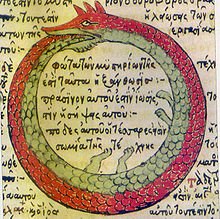
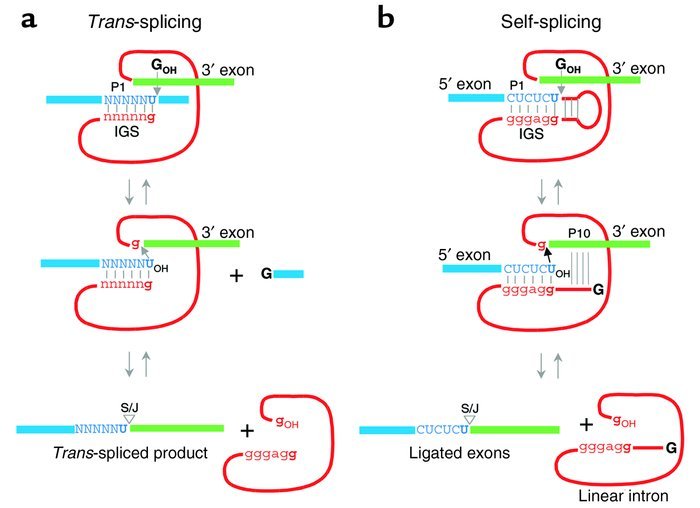
Certain types of RNA can fold back on themselves and have stretches of their nucleotides pair, so that you get a kind of lariat form. Where did I see this before? It reminds me of the alchemical symbol of the Ouroboros, the snake that bites its own tail and thereby gets to know itself. An ancient symbol of the self-reflective nature of consciousness.
 
Image of Ouroboros
Source: upload.wikimedia.org/wikipedia/commons/thumb/7/71/Serpiente_alquimica.jpg
Now certain RNA molecules can process i.e. modify themselves when they interact with themselves. Often this results in cutting of a part of itself (self-splicing), but it can also result in extending itself. 
Image of self-splicing RNA
Source: dm5migu4zj3pb.cloudfront.net/manuscripts/19000/19386/medium/JCI0319386.f1.jpg
In other words, these RNA molecules constitute a kind of code or language, if you wish, that recognises and reads itself and modifies itself as a consequence thereof. 
The only aspect which a priori appears to be missing from the earlier mentioned concept of a self-processing sentient language that creates reality by modifying itself, is the "sentience" aspect. You could argue that the molecular interactions that lead to the mutual recognition of the motifs are sensed in a certain way; it is not merely the fitting of pieces of a jigsaw puzzle: electronic charges attract and repel each other and hydrogen bonds are formed. If we accept this as a form of primitive sentience, this molecule hits all the marks to qualify as an instance of the previously defined concept. When it comes to RNA maps can be territories simultaneously. So a self-processing sentient language that creates reality by modifying itself might after all not be such a surreal concept.
In the last decades some idealist-type ideas have been suggested by outsiders with respect to philosophy, who suggest that virtually everything in reality is the result of such a "Recursive Self-Modification" of a code. In view of the RNA example, perhaps they do merit our consideration, if not for philosophical reasons then at least for the potential technological relevance or as an aesthetic enrichment of the human epistome (i.e. the complete collection of all that is known in imitation of terminologies such as genome and proteome).
Many of these ideas find their origin in a branch of physics called digital physics. Not energy, but information is considered to be at the root of reality. But this introduces a problem, because information implies meaning conveyed by symbolism and requires a mind or at least consciousness to recognise or make sense of the meaning. And this brings us back to the age-old problem of the Cartesian Mind-Body dualism. So if information is at the root of the manifested reality, consciousness must somehow be present at a deeper non-manifested level.
In this essay I will show you how a number different scientists and garden-variety philosophers have come up with a suggested solution to this problem, the common denominator of which is the notion of Recursive Self-Modification. I will give an overview of a number of such contemporary "mind=reality theories", which consider reality as the product of a cognitive self-processing language. I will discuss a number of similarities between Langan’s Cognitive Theoretic Model of the Universe (CTMU), Irwin’s Code Theoretic Axiom (CTA), Kaufman’s Unified Reality Theory (URT), Tsang’s Brain Fractal Theory (BFT) and Deli’s Science of Consciousness (SoC). I will also discuss the idiosyncrasies which makes each of these theories unique. Aspects as neural networks, fractals, category theory and the Yoneda Lemma and their implication for sentience, self-reference and self-processing will be discussed. Finally, I’ll try to suggest how these different complementary frameworks can be integrated in order to evolve towards a Theory of Everything, with the ultimate aim of providing a sound metaphysical basis for physics without the usual paradoxes that arise from the underlying self-reference.
Although I do not take most of these theories seriously over their whole scope, it is neither my intent to use this essay to systematically undermine each of these theories, nor is it my intent to defend them against criticism. Rather, I'd like to review them in order to distil useful notions worthy of further exploration.
...
Interested in reading more of this chapter? The book “Is Reality a Simulation? An Anthology”, which I, Antonin Tuynman (a.k.a. Technovedanta) edited and co-authored is now available as Hardcopy and as Kindle ebook. But you can get a free pdf, if you promise me to write a review and post it on Amazon, Goodreads and Lulu. For a free pdf send an email to iconomen at gmail dot com.

Thursday, 8 February 2018

Wednesday, 19 July 2017

Is structure fossilised sense?


In this essay I will compare the way experience is stored in structures with concepts from mathematical category theory. I will try to show that it is not unlikely that the involution of sensorial experience finds its expression in an observed evolution of biological species and behaves like a mapping process known in mathematical category theory as "Yoneda embedding". I will also argue that there is a primacy of sentience over matter, leading to an idealistic hypothesis of existence.
Warning/disclaimer: This essay is highly speculative and may rest on wrong interpretations. If you are not interested in metaphysics don't bother to read further or to reply.

Background


What is reality? Are the objects, entities and processes we observe with our senses really there? Or is what we observe a mind-fabricated hallucination? It is the ruling paradigm in science that our senses and brains filter the information we receive as an input and then fabricate a kind of simplified representation thereof, which we usually call "reality". But does the information we receive really correspond to anything out there? In the film "The Matrix" (1999), the main character Neo found out that everything he experienced before taking the red pill was not really there in a three dimensional tangible world, but rather a mental illusion fed to his brain by a vast computer system called the matrix to which he was connected in a kind of hibernation vessel. In other words, everything he experienced up till that moment was an illusion produced in the theatre of his brain by interplay of computer and brain information exchange.

This idea has also historical antecedents. Plato's cave with shadows that were taken for real and the notion of Maya in Hinduism and Buddhism. Modern developments in physics -in particular digital physics- invoking the so-called holographic principle have postulated the possibility that we are living in some sort of hologram, possibly projected from the two-dimensional surface of a black hole. Others even go as far as to speculate that we are living in a computer simulation. Perhaps not entirely like in the movie the Matrix, but the analogy is troubling.

Whatever is the higher truth as regards these ideas, at least we can make sense from what we observe. We can distinguish recurrent patterns and use them to our advantage. Technology is a proof, that however limited our understanding might be, at least we can employ this understanding in a predictable manner.

We may never know what reality really is like, but at least we can get an idea of what it is doing. The reproducibility of our knowledge suggests that what we observe is a meaningful and useful representation of the inner workings of reality. Perhaps even an isomorphous representation.

In mathematical category theory, if a category is like another category, there is a mapping between the two categories; a meaningful mapping that preserves the structure of the category when mapping it to another category. Such special structure-preserving mappings are called "functors".
The mappings from A to B can also be considered as the way A relates to B. The relation between A and B could then be considered as the sum of the maps from A to B and the maps from B to A. According to the philosopher Wittgenstein there are no things or objects in reality but only relations. It is the interplay between these relations which create the illusion of localised objects, where there are none. In fact quantum mechanics shows that everything is in fact a giant interference pattern of vibrations and vibrations are essentially non-local. Moreover everything is in a constant state of flux; there is no phenomenon that is exactly identical between two moments. Or as the Greek philosopher Heraclitus said: Panta rhei, ouden menei: Everything flows, nothing remains and "no man ever steps in the same river twice".

How relations build structure

Relations at their most fundamental level can then only be a functional process of mutual information exchange, which is continuously updated. The relations are expressed as vibrations, which result in resonance patterns of standing waves: There is a continuous waving and vibrating taking place, but what we observe is a form with a kind of stability.
In other words if we were to consider the forth- and back going vibrations between two points A and B as a mapping activity in progress, this mapping activity results in a physical (re)presentation of another dimension, which we call the standing wave and which we experience as an almost static thing.
In category theory we call mappings morphisms. Mappings show the maps between "objects" (characters, strings, mathematical objects, sets etc.).
A special functor (a mapping between categories) in category theory is the Yoneda functor. Whereas functors normally map objects, the Yoneda functor takes morphisms (mappings) themselves as objects and maps these into a set, which is a new object. (A map of maps so to say).
The analogy struck me. I wondered whether if relations are sets of mappings and such a set can be considered an object, there is at least an artistic similarity with my standing wave idea. I'd perhaps even go so far as to formulate the hypothesis that the structure of an object is a faithful (not in mathematical sense) representation of the functional relations from which it is built.
Perhaps this example is a bit far-fetched, as it is disputable whether vibrations can be considered as relations. But what happens in the brain, may be a better analogy.
Memories in brains are not stored locally as in computers but in distributed ways. Brains store memories in a highly "Wittgensteinian" manner: The patterns that build a concept or an image in the mind are stored functionally in flux patterns of neurotransmitters between neurons and structurally in terms of links between synaptic links between dendrites and axons (the input and output channels) of different neurons. It is the resulting pattern of relations which maps an event or object we have memorised. Whenever we experience something new, the molecular fluxes stimulate synaptic growth to connect neurons. In this way, sensing, which is a functional process forces the formation of structures. It is like a Yoneda mapping taking place in situ in concrete form: the sensorial patterns we observe and categorise according to a certain pattern similarity in our brains are then stored as a new pattern: The morphisms crystallise or fossilise in a set of synaptic links.
But this type of physical direct mapping does not only occur in the brain; at the level of DNA experiences often result in parts of the DNA being post-translationally modified, most often in the form of methylation. The methylation pattern of the DNA can influence whether a gene is switched on or off. It can also be inherited. This is the field of epi-genetics. Environmental influences can strongly influence the way genes can or cannot be expressed as a consequence of environment-induced methylation. This can also render a gene more prone or vulnerable to mutation or influence the way genes are copied or even multiplied upon cell division. In other words certain types of experiences are also stored on the level of the genes or can result in mutations at the DNA level. Again this is an example how sensing the environment and building a relation with the environment is mapped physically in a set of information. Environmental morphisms fossilising in the form of material and informational structure.
In other words, I have drawn an analogy between the abstract way a Yoneda functor maps and embeds morphisms into a set and the concrete way the brain and the epigenome store information resulting from sensorial input. The way the sensorial input is processed corresponds to the morphisms and the concrete stored information in synaptic links or methylation patterns correspond to the embedded set.
Also in this way structure can be considered as a form of fossilised sense.

Yoneda mapping as an analogy for meditation

One of the techniques in Indian meditation is the "Panchadasi" technique. You mentally try to throw your light on a topic of consideration from 15 different perspectives. By doing so, you probe the object functionally and structurally. It is like having an object defined by a few dots and then trying to connect the dots to see what it represents. In fact you are mapping relations between the dots, and the more you progress from these relations you suddenly start to see what the intended object was. From partial links at a certain moment the whole which is more than the sum of parts reveals itself. By performing this technique and considering a topic from as many perspectives as possible, you build as many ontological relations in your mind as possible. At a certain moment, the framework of ontological relations is sufficient to understand the whole. No longer do you experience a broom, a hose and a drum, but suddenly the elephant -of which you had considered the tail, trump and ears separately, without knowing what they were- snaps into your experience. This holistic experience of the phenomenon of contemplation can even result in that you start to feel what it must be "like" to be this phenomenon. Not only do functional relationships reveal a structure, structural relationships can also reveal function.
To speak in category language, not only do the morphisms lead to a representation in a set, but the relations of the objects in the set can by an inverse functor also be back-translated into the morphisms they originated from.
The meditative process thus might be a way to experience "what it is like to be" concerning the object of contemplation.  In Latin this is called "quale" from which the word quality derives. Neurosciences often speak of "qualia" as the qualitative aspects of observation, such as the "redness" of a tomato. Meditation is often intended to achieve oneness with the object of contemplation. This is achieved by experiencing the "what it is like-ness" of the object. Perhaps a process which resembles Yoneda embedding or the reverse thereof is involved in this experience.
Funny enough, one of the basic tenets of category theory is that if a category is "like" another category there is a meaningful mapping which preserves the structure of the category (functors).

Pancomputational Panpsychic Akasha

In my book "Transcendental metaphysics" I argue that the ground of existence is "primordial consciousness" (i.e. sentience per se if you prefer). From this formless all-pervading filed, informational units arise, which form a kind of neural computational network in the so-called the quantum vacuum, which has been equated with the Indian concept of the "Akasha". The Akasha even allows for a kind of digital processing in addition thereto. If reality is indeed a computational substrate involving information processing as digital physics suggests, there must be a consciousness to make sense of the information (otherwise it is gibberish). This leads to my hypothesis of pancomputational panpsychism. As this network of reality as a whole is considered sentient in this model, perhaps I can also speculate that the very way in which structures arise in this model is via Yoneda embedding. It is interesting to note that Yoneda embedding requires that the functor which operates the mapping does so from a "locally small category". This is important because I have suggested in earlier posts that sentience is present at the smallest level of reality which can be considered to have a certain individuality and relative locality. If reality indeed creates structure by fossilising sensed experiences, then this is not in contradiction with my panpsychic hypothesis. Moreover the fractal of panpsychic entities, which I have proposed, perfectly fits the idea that functions and structures are each other's transform.
In my model your localised awareness inhabits a vessel which is made out of smaller entities (your cells), which can be considered as a bunch of smaller localised entities. The awareness of a cell inhabits a vessel made by atoms, which in turn can be considered as a bunch of smaller localised entities with a minute form of individual awareness. Thus you get a fractal of entities that on the one hand are sensing entities themselves and on the other hand form structured vessels in cooperation. Each entity is then at one level a functional sensorial living entity and at the same time the structural fossilised building block of a higher aggregation level.

I don't say this is my belief or an absolute truth to me. It's a speculative artistic process of associations, which I explore in the hope that one day I will be able to integrate them into a verifiable hypothesis. Consider these my metaphysical musings and please do not take any speculation for a fact in this essay. Perhaps my analogies are not even valid since I am not a mathematician. But if they are I hope my musings will be read by one of them and inspire them, to help me prove my ideas.

Consciousness

In a previous article I have also suggested that primordial consciousness might operate to generate information by self-representation. Again this fits the notion of Yoneda embedding. Self-representation or self-reproduction is a concrete analogy of mapping the functional consciousness process into a fossilised structure that can be experienced , so that the knower generates information as known and by observing its self-generated information comes to know itself as the Ouroboros from alchemy biting its own tail.

Conclusion

I hope to have shown that the abstract mapping of morphisms into sets in mathematical category theory may have an equivalent in the way structures arise in physics and biology. The process of Yoneda embedding may not only be involved in such concrete examples but also in meditative processes as well as in the ontogenesis of existence from primordial consciousness.

By Antonin Tuynman a.k.a Technovedanta; inspired by ideas from Eric D.Ryser.
You can find my book here.
Image from http://eresaw.deviantart.com/art/Soap-Bubble-Ballet-293874327

Thursday, 13 July 2017

Tsang's Brain Fractal Theory: The ultimate algorithm for AGI


In this chapter I will discuss how Tsang's Fractal Brain Theory describes a way to implement the evolutionary algorithm of intelligence in a computer environment to generate Artificial General Intelligence.

Background


In my previous book "Is Intelligence an Algorithm?" I described an algorithm that evolution follows to generate complexity. To my great surprise I found the same ingredients back in the book "Fractal Brain Theory", although differently presented. This chapter is the first of a series of a sequel to my previous book.
I described how when a (living) system encounters a problem such as a lack of resources, this gives the system a stimulus to start to probe for a variety of alternatives or other solutions.
Quote from my previous book:
Nature will now generate a plethora of alternatives by combining elements from the environment with the system. 
This includes changes such as mutations.
In Tsang's book an equivalent is found in that the system differentiates or diverges.
From the probing or testing of these alternatives by the system, the system abstracts patterns. (Screening of relational “Syntheses”.) From these the most successful alternative strategies can be selected. (Elimination, Pruning of Syntheses and Emergence of new “Theses”.)
This plays a role in what Tsang calls "intersection", which I will discuss later in this chapter.
Quote from my previous book:
This can be repeated on a heterarchical level between groups of entities or (living or non-living) systems (such as bacterial colonies or animal societies). When contending groups encounter each other, this gives a stimulus to start a so-called “Intergroup tournament”. The tournament can lead to a mutual probing of the distinctions between the groups. Nature will screen which elements from the contender can be copied and integrated and which ones should be discarded. This can result in the formation of 1) a “niche” (each group specialises in a niche such that it does not poach on the contender’s preserves); 2) a “symbiosis”: the groups learn to cohabitate peacefully together and provide each other with a service, resulting in a transactional scenario of a win-win situation); or 3) an exchange of those features which are different between the groups (“mimicking”). Thus the system adapts itself to its environment.
The most promising strategies ideally result in symbiosis, a unification of features toward which the system will strive. 
In Tsang's book I found an equivalent which he calls convergence.
Quote from my previous book:
The system will try to resonate “morphogenetically” (i.e. in form, as dictated by its genetic make-up) with its new environment and thereby adapt to it. This is Nature’s way of continuously striving for more complexity and incorporation of mutual features, as this assures more adaptability to and integration with the environment and hence increased chances for survival. In other words Nature’s intelligence algorithm is essentially integrative: It tries to unite, to combine apparent opposites.
Now one of the most interesting points I found in Tsang's book was the way he described the selection process (which I called the screening and pruning), which he calls the intersection of the convergence and divergence. This is one of the points that I will discuss in more detail in this chapter.
The other point is that Nature is a system performing mapping. I discussed this in my essay: "Is structure fossilised sense". Likewise I find that Tsang describes mapping as the unifying process underlying all natural processes.
Finally, Tsang speaks about a recursive self-modifying process, in which the process takes itself as an object and maps this. This is Yoneda embedding, which I also discussed in my article on structure being fossilised sense. Moreover, in my article on sentience I suggested that this form of self-representation is the very ontogenetic process of reality generation.

Mapping

Tsang convincingly shows that nature both on the genetic as well as the brain level cunningly exploits the process of making binary trees to arrive at an ontogenetic process which observes rules of symmetry and symmetry breaking, recursive self-modification and warranting self-similarity over different scales. The brain maps its experiences, its sensory data observing a hierarchical process involving binary trees, and these are reflected in the generation of corresponding structures at the neuronal level in the form of axonal and dendritic branching  (but also at the genetic level: e.g. epigenetic markers). Moreover, this forward chaining process is mimicked by a backward chaining process in the motor neurons. Both the structural modifications and the motor neuron actions can be considered as mappings of the sensory process: (s)ensing translates into (r)econstruction in terms of Tsang. From (s)timulus to (r)esponse.

Amplification, Reproduction and seed.

Nature has found both at the neuronal and genetic level a system to reproduce itself, which is a special kind of recursive mapping which takes itself as object to generate isomorphic structures, we could call this amplification. At the same time, there is a kind of randomisation process going on allowing for mutations and changes, a differentiation can occur in the copies. At the level of DNA this is obvious in the form of point mutations, deletions and insertions, but at the brain level as well plasticity is rewarded allowing for morphological differentiation and asymmetric linking up of the neurons. Moreover, a Yoneda type mapping process occurs in that the mapping process itself becomes the object of the mapping process. We can reflect on how we reflect and this is reflected in new links being created at the neuronal level. Now that we understand that this type of reflecting is a Yoneda-type of mapping we are actually doing this very thing in situ. The process which maps and creates our neuronal links is mapped to itself. You have now created a mapping of the recursive process by the recursive process. You have done so by creating a hierarchical binary tree. You have crystallised (or fossilised) sensing and function into structure. This is what nature does, it evolves evolvability by a process which Tsang calls recursive self-modification. A hierarchical binary tree generation process which is the unifying process in our ontogenesis.
Tsang moreover shows that the brain is like a fractal structure as every idiosyncratic aspect of the brain can be mapped to a structure or function at the genetic level. After all our genome encodes precisely how our brain's architecture should be formed. Our genome in a certain sense is a brain in seed form.
Interestingly, Stephen King a computer scientist (not the horror writer), called this process of self-generation the generation of a null-representation, a self-representation or a seed, which can grow out into a full blown new entity.

Divergence and Differentiation

And Tsang adds the modifying and divergence or symmetry breaking aspect to it. Some branches will get more attention than others. Neurons have a kind of background random spiking activity, which can be rewarded if an interaction is generated and a connection is built. This creates a divergence. If a cell would simply undergo a doubling process by division without any differentiation, all you would get is a homogeneous essentially spherical blob of cells. Fortunately, nature has invented a way to differentiate by employing so-called morphogens (special chemicals that cells produce), the presence of which tells the cell to differentiate, by silencing certain parts of the DNA and switching on other parts. These morphogens form a gradient, so that not every cell is differentiated, but only the ones where the morphogen concentration is high. Even on the neuronal level there is a differentiation in type, there are activating and inhibitory neurons; there are also spindle cells for long distance information transfer.

Screening, Pruning, Intersection and Selection

I described how nature has to screen and prune the variety of alternatives it has generated to select the most promising ones. Darwin's survival of the fittest. But how does it pull off this trick if a mapping process underlies the ontogenesis? It is here that I found Tsang's description most elegant and inspiring. It employs a combination of forward chaining and backward chaining, just like certain type of heuristics in artificial intelligence. In a literal sense the sensory  motor neurons expand and branch until they meet each other and only those who meet are selected, because they form a link! Just like  a forward chaining heuristic starting from the problem meets a backward chaining heuristic starting from the solution. Tsang describes this as Bayes inverse probability Rule in action. Bayesian probability can be expressed as the chance that B occurs when A is present  P(B ¦ A) being equal to the chance that A occurs multiplied by the chance that A occurs when B is presented and divided by the chance that B occurs: P (B ¦ A) = P(A)*P(A ¦ B)/P(B).
The chance that B occurs when A is present is like the forward chaining heuristic and the chance that A occurs when B is present as the backward chaining heuristic. Where the branches meet a connection is formed and metaphorically an intersection is formed. This is how neurons select. Neurons that wire together fire together. Enhanced flow through a neuron attracts the attention of other neurons, which will then also benefit from enhanced flow. This is like publicity. This is what Howard Bloom calls the "Matthew" principle: To those who have it shall be given, from those who have not it shall be taken away. There is a mutual rewarding going on, which is rather exclusive. Only really new ontologies to be created may be able pull off the trick of including the previously excluded neurons.
But only those who can create a proper linkage create a connection, and Tsang here uses the lock and key metaphor. The conjugation or linking up at every level can only occur if the key of the backward chaining heuristic fits the lock of the forward chaining heuristic. In order to select which ones can link up, a scoring system is needed. Tsang proposes that the lock comes before the keys otherwise we wouldn't have anything to score the keys with. The female precedes the male, in this chicken-and-egg problem.

Convergence and Integration

This shows that ontogenesis is more than differentiation and selection only. The parts must also start to work together, they must be integrated into a whole. A meta-system transition must occur for the cells to group into an organ. And again this trick is pulled off by mapping. Yes, mathematical category theory is a very powerful concept, for describing reality as we know it. Here we employ linking up of the various  mapped elements. This is the cooperative symbiotic part of the evolutionary search engine, allowing the mapped conjugated entities to map into a convergent hierarchical tree. And this new entity can then be submitted to a new round of recursive self-modification, giving rise to the steps I described as intergroup tournament, distinction probing and (further) symbiosis.

Artificial Intelligence

Tsang believes that the ingredients of symmetry, self-similarity and recursion resulting in a simple self-modifying recursive algorithm, which creates binary trees, may be the key to unlocking the secret of Artificial general Intelligence: Creating AI which is context independent and which can achieve or surpass the human level of intelligence. Provided that Tsang in his endeavours in AI includes the elements of selection and integration he has described, this may indeed be a promising novel avenue in this field. But we must not forget that it took nature billions of years to arrive at the complexity we presently have. The different layers and structures in the brain (cerebellum, hypothalamus, pituary gland, hypophysis, hippocampus, amygdala, cerebral cortex etc.) have a very special fine-tuned architecture, which employs a great variety of neurotransmitters. If Tsang's future algorithm is successful it will take quite some cycles and extensive pruning and selection, before a human  level AGI evolves from it. On the other hand the ever increasing speed at which this can occur and the ever increasing resources in terms of memory and miniaturisation according to Moore's law, may pull-off this trick faster than we think. Because it has the very notion of representation and recursive self-modification at its heart.
Noteworthy, Dr Joe Tsien has recently shown that intelligence indeed follows a “neural network” type algorithm (not a traditional von Neumann style algorithm). The more thought, the more cliques join in, Tsien says. The basis of Tsien’s Theory of Connectivity is the algorithm, n=2ⁱ-1, which defines how many cliques are needed for a “Functional Connectivity Motif” to arise. This enabled the scientists to predict the number of cliques needed to recognise options in their testing of the theory. The  2ⁱ in this formula represents the number of neurons that join in, which follows exactly the binary tree indicated by Tsang!

Conclusion

We have seen that Tsang's brain fractal theory can be mapped quite accurately to my "intelligence algorithm" and "structure is fossilised sense" ideas. We have seen that Tsang provides serious improvements thereof in terms of binary trees, an intersection selection and connection process and a recursive self-modifying process. We have also seen that this may be a serious candidate to create human level AGI which may perhaps one day herald the advent of the technological singularity. Thus Tsang lifts the veil of the underlying algorithm of existence as a whole, a process, which the Greek called Apokalypsis. The Fractal Brain Theory by Wai H.Tsang, wholeheartedly recommended.